Many mechanics in D&D 5e and Pathfinder 2 are exactly the same. There are a few, however, that differ substantially, and oddly I don't see much discussion about it online. This blog post is my effort to remedy that.
Proficiency isn't global
In 5e, you have exactly one Proficiency Bonus. It starts at +2, and then increases by 1 every 5 levels until it reaches +5 for levels 15 to 20. When you are proficient in something, you add that Proficiency Bonus.
This is obviously highly reductive. It means that your character becomes more proficient at completely unrelated things at the same exact time, every time. When you reach level 5, you're suddenly +3 proficient in Acrobatics and also in Intimidation and also in Survival, and so on. Nobody complains about this because it keeps things simple. I'm not complaining about it, I'm only describing it. I appreciate its simplicity, and admire the minimalist design.
In Pathfinder 2, proficiency is not a global value. Every skill, every weapon, every armour type, spell attack, saving throw, and so on, has its own Proficiency Rank. The ranks are:
- Training (+2)
- Expert (+4)
- Master (+6)
- Legendary (+8)
You are not proficient in everything by default. You gain proficiency in something according to your class, or sometimes special options during character building.
When you are proficient with something, you add your Proficiency Rank to your d20 roll.
Proficiency includes your current level
In Pathfinder 2, Proficiency Bonus is not the same as Proficiency Rank.
As a Proficiency Bonus, you add your current level to any roll that includes a Proficiency Ranking (Trained/Expert/Master/Legendary). This is why there's a separate Prof box next to every Proficiency Ranking checkbox (highlighted in red in this image):
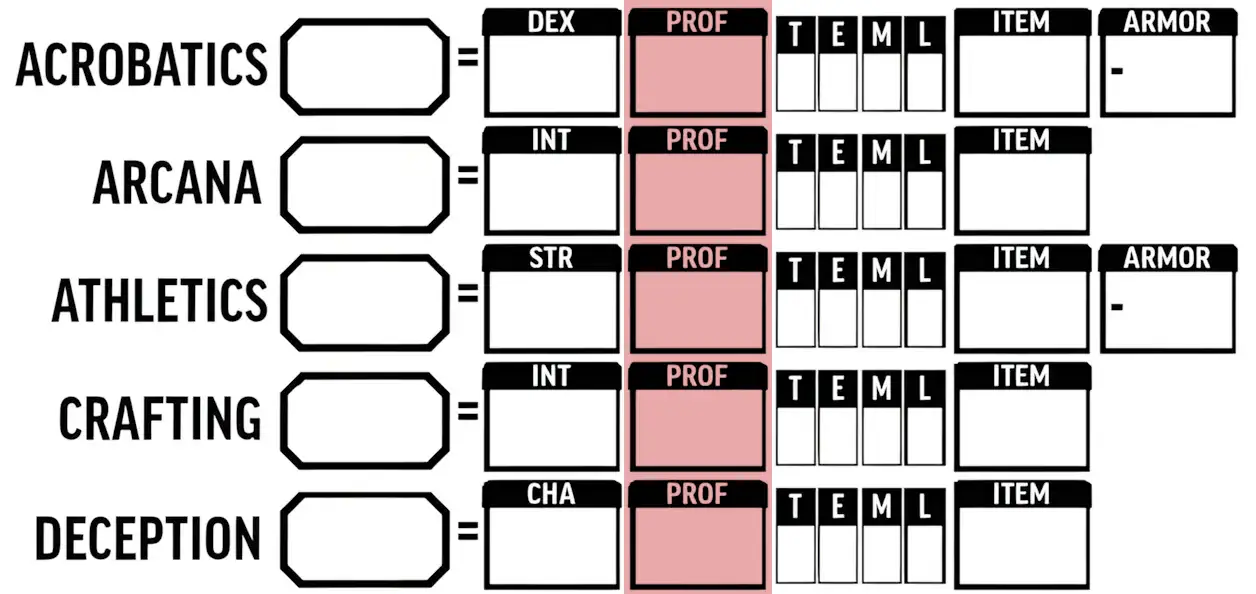
As long as you have a Proficiency Rank, you can write your current level in this box and add it to your roll. This is described on page 444 of the original Core Rulebook, and in the inverse in the variant rule section of the Game Mastery Guide on page 198.
If you are Untrained (you have no Proficiency Rank), then you get no Proficiency Bonus.
Your Proficiency Ranking is a modifier that describes your level of training with something, and implies that you also get a Proficiency Bonus. Your Proficiency Bonus is your level.
Surprise errata
There is an unacknowledged error on page 31 of the original Core Rulebook, in the Leveling-up Checklist section:
Increase all of your proficiency bonuses by 1 from your new level, and make other increases to your proficiency bonuses as necessary from skill increases or other class features...
Following these instructions, you would forever be off by 1, because you wouldn't gain a proficiency bonus +1 until you leveled up from 1 to 2. Also, you would have a lower Proficiency Bonus in any skill you did not gain at level 1 (drastically, if you gained a skill at a very high level.)
Proficiency in Pathfinder 2
As you can imagine, having a Proficiency Rank plus a Proficiency Bonus can make for some very high roll results. This is often the most surprising thing about Pathfinder 2 for new players. This isn't 5e, where everything's constrained from 1 to 20 (or 40, in high-level play.) At high levels in Pathfinder 2, you can roll a d20 and get a result of 50 or 60.
Another effect of Pathfinder 2 proficiency is that rolls for different skills and weapons can be substantially different depending on your ranking. You can be a Master at one thing and only Trained at something else. You're proficient in both, but you're better at one than the other.
High rolls in Pathfinder 2 are normal. Obviously, high-level threats and monsters are built accordingly, and that provides a lot of flexibility for the game master and adventure designers. Not everything in the world is on a difficulty scale from 1 to 20, as it seems to be in 5e. Things can be literally impossible for low level characters, while other things can be nearly impossible to fail for high level characters.
Now you know how proficiency in Pathfinder 2 works! Add +2 to your Pathfinder rules rolls from now on.