No matter how you measure it, I'm a late-comer to tabletop Warhammer 40,000. I've been a reader of Warhammer fiction, and a casual player of Warhammer video games, since the early 2000s but I didn't start playing it on the tabletop until 2020. Because there are no indications that I will not invent a time machine, I've been thinking a lot of what advice I'll give to my past self about tabletop gaming. If I had to do it all over again, here's how I might have gotten into narrative Warhammer 40,000:
- Buy 3 books: Buy the Core Rulebook so you know how to play the game, the Imperial Agents codex for the heroes, and Chaos Space Marines codex for the villains.
- Buy a few models: Don't try to get all the models because you don't know what you like yet. Buy up to 3 models from each codex. Try to get a model that comes in a blister pack, but some models are only available in a box. Don't worry too much about matching the model with the photo of the model in the codex. As long as the model looks cool to you and approximates what you see in the codex, that'll work.
- Write or roll a scenario: The Missions in the back of the Core Rulebook are fine, but they're just combat. If you want to really play Warhammer 40,000 the way the [true] God Emperor of Man intended, then you need a story. You can write one, or use random tables to generate one.
As an alternative, you can follow the same path but for Necromunda. It's the same concept (buy 3 books, buy miniatures, invent a story, and play), and in fact Necromunda is arguably a better fit by nature, but the theme is noticeably different (think of Necromunda as Mad Max compared to Warhammer 40,000 as Star Wars.)
When you play a game, think about it this way: D&D is structured as a story with combat, while Warhammer is combat with a story. In Warhammer, you tell a story through game play, but unlike D&D everything happens within the structure of a turn (a little like a cRPG video game). Characters can talk or bargain with one another, they can explore, and they can fight, but no matter what happens you're never really out of combat until the game is over.
And once the game is over, you still get to play because you have Crusade administration and character updates to make. This kind of narrative play can keep you entertained for years.
Here's how I came up with this 3-book/miniature/generate/play formula.
Kill Team as a subset of total war
In a previous article, I've said that Kill Team version 1 is the best way to start playing Warhammer 40,000. I still think that's true, but there's a caveat to it now: Kill Team is a great way to start if you're interested in unified troops. In other words, if you want something that feels like an army, with uniformity and rank structure, then Kill Team, with few exceptions, provides that. You can buy a box of soldiers from your local Games Workshop store, build and paint them, and you've pretty much got your Kill Team. They're all basically the same, aside from one or 2 weapon options, and it's easy to imagine them as a part of a much larger army, but that they're on their own for the special mission you're playing.
That's mostly how Kill Teams have been designed. It's a sensible strategy for the Kill Team game, because Kill Team is, after all, a subset of Warhammer 40,000, which requires lots and lots of boxes of soldiers. All those boxes exist for Warhammer 40,000, so it makes sense to also use them, albeit in fewer numbers, for Kill Team.
If you intend to play big epic battles, then Kill Team does make sense as a skirmish game. Start with Kill Team, and scale up to big epic battles in Warhammer 40,000 proper.
But if you're more entertained by a rag-tag group of adventurers wandering through space stations or secret underground bunkers or dungeons, then there's the alternate route in the style of the very first Warhammer 40,000 source book, called Rogue Trader.
Rogue traders and rag-tag bands of heroes
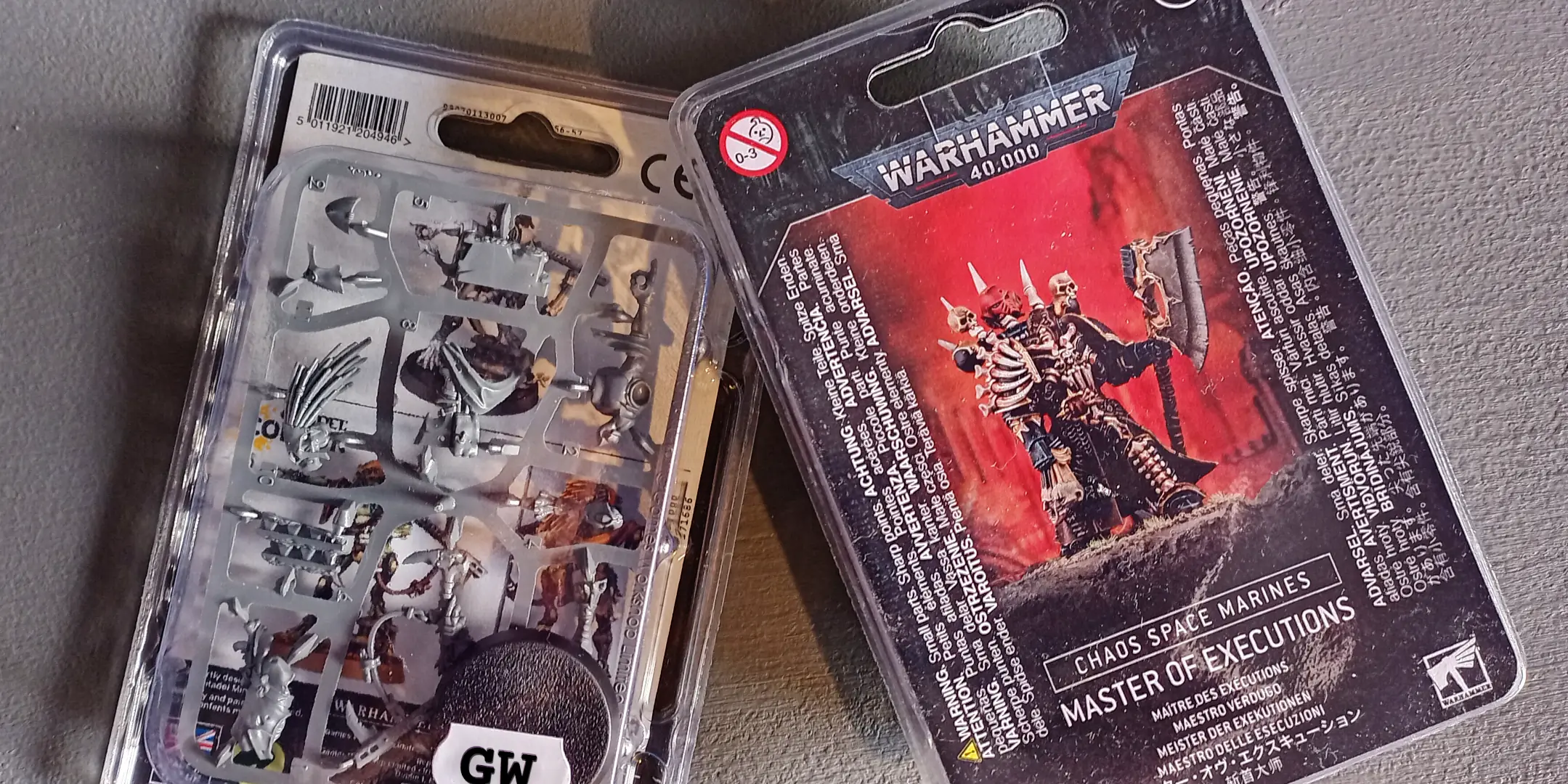
While many Citadel models come in boxes as squads of 10 soldiers, there are also single miniatures sold in blister packs. A blister pack is a plastic (really ought to be cardboard) packet containing a single miniature, usually with the Character keyword in its profile. The benefits of this include:
- Gradual investment: Games get expensive. I don't care how much money you have, it's silly to buy hundreds of miniatures for a game you haven't played yet.
- Pacing: It makes sense to gradually invest in miniatures at the pace suitable to building and painting. When you buy a box of 10 miniatures, you must build them. After you've built them, you now have 10 miniatures to paint. Depending on how much free time you have for your hobby, just 1 miniature can feasibly takes days to complete. The sensible pace is to buy a single miniature at a time.
- Taste test: You might love the look and the lore of a space marine (or whatever) but that doesn't mean you'll love how it plays on the tabletop. I love Skitarii, but on the tabletop they're just sponges for my Techno-archaeologist. I bought them the wrong way round: I should have gotten the Techno-archaeologist first, and supplemented him with Skitarii when my battles started escalating in size and threat.
The Imperial Agents codex offers the most diverse range of player options. It's got:
- Assassins
- Adeptus Arbites
- Adepta Sororitas and a Ministorum Priest
- Deathwatch (Space Marines)
- Grey Knights (Space Marines)
- Inquisitors and Inquisitorial agents
- Navigators and Voidsmen
- Rogue Traders
- Tanks
Literally, what else is there in the Imperium? That pretty much covers everything. You can buy most of those as blister packs, and the rest in boxes. And if you do buy a whole box of some subfaction then you can probably find datasheets in this book that are close enough to suit. I could run Skitarii using the Exaction Squad or as Voidsmen rules. I have a handful of Space Marines that I use with Deathwatch rules, I have Terminators I use with Grey Knight rules (leaving out the Hammerhand Psychic ability). The book provides a broad spectrum of profiles, so with a little imagination you're likely to find whatever you need in its datasheets.
The same is true for Chaos Space Marines. It's got datasheets for Chaos Space Marines, a smattering of dæmons, Chaos Spawn, Possessed, Havocs, and some war engines. It's likely you'll find something suitable for any evil-looking Warhammer miniature you buy in a blisterpack, and for a fair few boxes.
Each datasheet profile in each book has a points cost associated with it. Use these to help you balance your game. If you've built a little army of 120 points from your 2 or 3 Imperial Agents codex, then build an opposing army of a similar point value from the Chaos Space Marines codex. As your miniature collection grows, your total points will get higher, and that's perfectly acceptable as long as your baddies grow at basically the same rate.
Characters and sudden death
Warhammer 40,000 rules assume you're playing a big epic war with many units of 10 miniatures each on the battlefield. A Character model is attached to a unit basically so that unit can add to the character model's damage output, and also soak up incoming Wounds. In other words, my Technoarchaeologist lasts for several rounds in a big game partly because his loyal Skitarii keep throwing themselves in front of him for the honour of taking a bullet meant for him. D&D grants characters 10 hit points at level 1, and 100 by level 10, but in Warhammer your character has maybe 4 Wounds, so you're uncomfortably vulnerable without a squad of bullet fodder to soak up damage.
I don't adjust for the fragility of my heroes. This is normal, and it's good. When you're playing with very small armies (2 or 3 models on each side), quick "death" translates into quick games, which usually aren't that quick because you're still struggling to remember all the rules. As you learn the rules and grow your army to 8 or 10 models, your games start to last longer because, despite knowing the rules, you've now got more total Wounds.
Warhammer's Crusade rules don't expect you to treat removal as death. When a character reachs 0 Wounds, then that character is removed from the battlefield. Your character is Out of Action, not dead. After the game is over, you roll to see whether each removed model has lost a battle Honour or gained a Battle Scar. The next game, your character's back in action, maybe worse for the wear but, then again, doesn't that in itself add character to your character? Sure it does!
Manageable amounts of narrative hammer
Approaching Warhammer as a narrative game does fly in the face of what Games Workshop expects. It's obvious from the game books and marketing campaigns that Warhammer is mainly targeting competitive tournaments. However, there is official support for narrative play in the Crusade rules, and obviously in the personal agency of players.
A narrative game, by definition, starts with a story. And every story needs a hero (or anti-hero, if you prefer.) When you buy into Warhammer one miniature at a time with a nice and broad faction like Imperial Agents or Chaos Space Marines, you're almost encouraged by the variety of choice to develop and play individual characters. That's also, not coincidentally, the way the original source book was written. Just because it's old doesn't make it the "correct" way to play, but maybe there's a natural progression here: Start small, and let your stories (and armies) grow over time, just as Warhammer itself grew from a small band of Rogue Traders into huge regiments of Space Marines.
When you play just a handful of character models, you don't get lost in a squad of 10 soldiers among 10 other squads of 10 soldiers each. All you've got, as a storyteller and as a player, is your Rogue Trader (or whatever) and your rag-tag band of heroes. Finding a personal story in that is a lot easier than finding one in a mass battle.