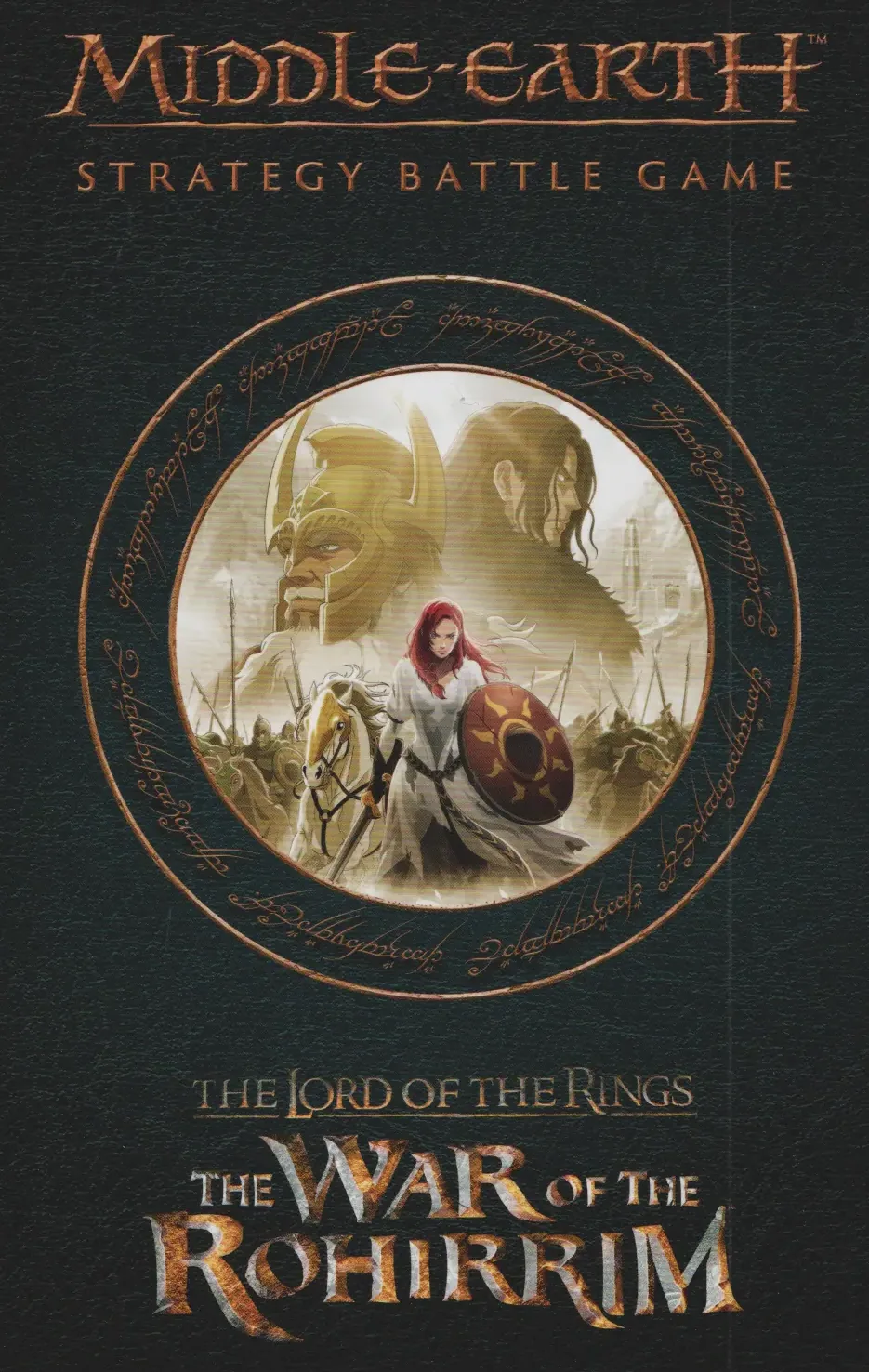
In 2025, Games Workshop released a War of the Rohirrim campaign book, as a special order only, for Middle-earth Strategy Battle Game. I enjoyed War of the Rohirrim a lot more than I'd expected to, and I still regret not buying the Quest of the Ring Bearer campaign book, so I ordered this campaign book as soon as it was available. It's a paperback campaign book, and only 48 pages long, but it's full of a whole lot of not-quite-canon fun. This is my review of the book, with minor spoilers for the movie plot and the campaign book itself.
Setup
What's not in this book, unlike the big campaign books for Warhammer 40,000, is lore. It's assumed that you own the book because you saw the movie, so the gets straight to business. There are 11 scenarios, and they strictly follow the events of the movie. If you want to play them as written, you need a bunch of Middle-Earth miniatures. Personally, I don't own many Middle-Earth miniatures. I have the Fellowship (War of the Rohirrim is before their time, obviously), and I did buy Héra as a miniature, and aside from that I have a bunch of generic fantasy miniatures I use for dnd games, Deth Wizards and other fantasy games. My battles in Middle-Earth didn't end up looking much like the photos in the book, but that didn't make it any less fun to play.
Scenarios
I've played all 11 scenarios in the book, and have battle reports on each. I've got thoughts on each scenario after its battle report, but to summarise: This is the sort of campaign book I had wanted Pariah Nexus and Armageddon to be. It's driven entirely by the story, with each scenario flowing logically into the next one. The outcomes of one scenario even has an affect on the next scenario.
Significantly, it feels like a campaign. You're not playing a series of disconnected adventures with objectives and settings that make no sense. I'll never forget my frustration in Pariah Nexus when I reached the Into the Tomb mission and realised that the missions after that weren't set in the tomb. You descend into a dungeon, and then step right back out to go shut down more nodes, or recover yet more Noctolith from the planet surface. In my imagination, I thought the missions had been leading me to a great final confrontation in or around a pylon (like in the lore), where I'd bring a halt to the Stilling or something like that.
War of the Rohirrim tells a clear story, from start to finish. You're playing the story of the movie, as if you were playing a historical wargame. Each battle is linked, as with The Slidecrown Sundering campaign that started in White Dwarf 493, or the Quest of the Ringbearer book. You know the way the battle ended on the screen, but this is your chance to alter history.
You might think that having a story with so much detail would be difficult to bring to the tabletop. Every scenario tells you exactly what miniatures to use, and some have pretty specific battlefield layouts. But of course nobody's monitoring to make sure you're playing the scenarios with only the miniatures listed in the book, or on a battlefield exactly as shown. In fact, I find that the labourious detail in the scenarios make it easier for me to spin the story to suit what I actually have in my game room. My playthrough of War of the Rohirrim was set in an alternate Middle Earth timeline, where the One Ring doesn't exist and the Fellowship is just a warband against an orc incursion. I rewrote the story to suit what I was seeing on my tabletop, but all I really had to do to "rewrite" it was swap out names. That's not Helm Hammerhand and Freca fighting in the first scenario, that's actually Aragorn and Turuk the orc captain. That's not a Mûmak on the plains of Edoras, it's a hill giant being controlled by a goblin. And so on. It's easy to rewrite a story that already exists.
Compare that to the vagaries of poor old Pariah Nexus, where the story that the missions told just didn't seem to be the same story that the lore told. Or at least, not as a sequence. Each individual mission reflected the lore that appeared in the first half of the book, but it was a lot harder than I'd expected to string them together into a campaign (which is a weird problem to have in a book written specifically as a campaign book.)
Crafting
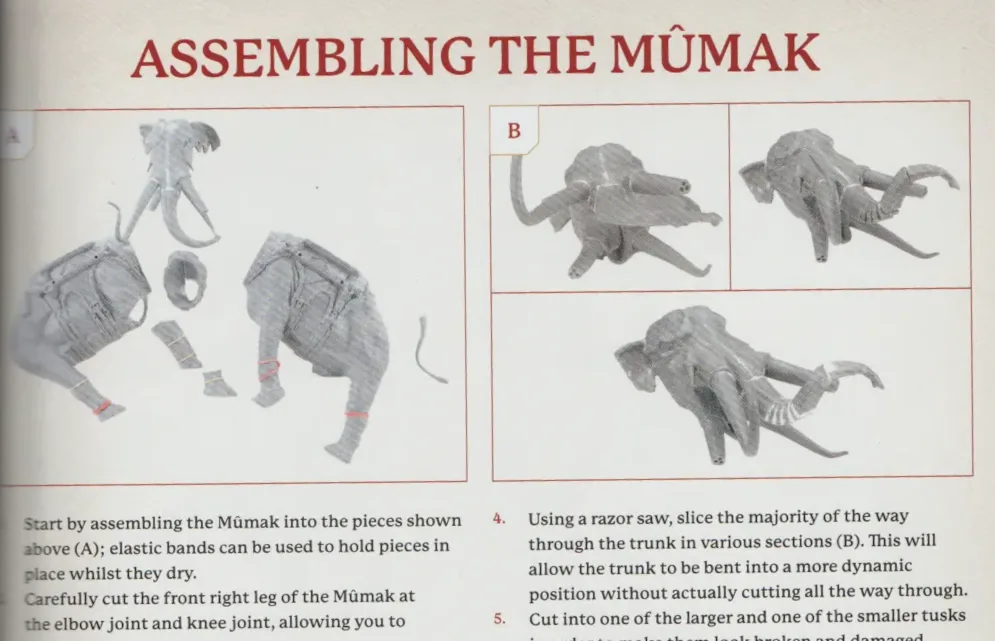
The final 16 pages of the book are dedicated to the arts and craft side of the hobby. I'm not talking about some cursory paint tutorials, I mean there are build instructions for encampments, and conversion tutorials to make a town building into a burned-out building, and a Mûmak miniature into a rabid Mûmak.
The ruined building tutorial assumes you have a model building already, and only adds rafters to the area you cut a hole in, so you're not scratch-building a house from cardboard. But these instructions are clear and focused, and they don't rely on specialty materials. Yes, they're carefully designed to require the purchase of a Citadel model or two, but first of all you probably have done that any way, and secondly if you prefer to just convert a cardboard box into the foundation of your burned-out cottage, that doesn't take a whole lot of explanation. The tricky part are the rafters, or the frame for the tent or the campfire, and that's the stuff that's in this book.
This kind of content is a nice reminder that a good portion of the wargaming hobby is just about being creative. Grab some small things that were destined for the rubbish bin and convert them into terrain. It's fun, it's creative, and it helps you formulate the story your games are going to tell.
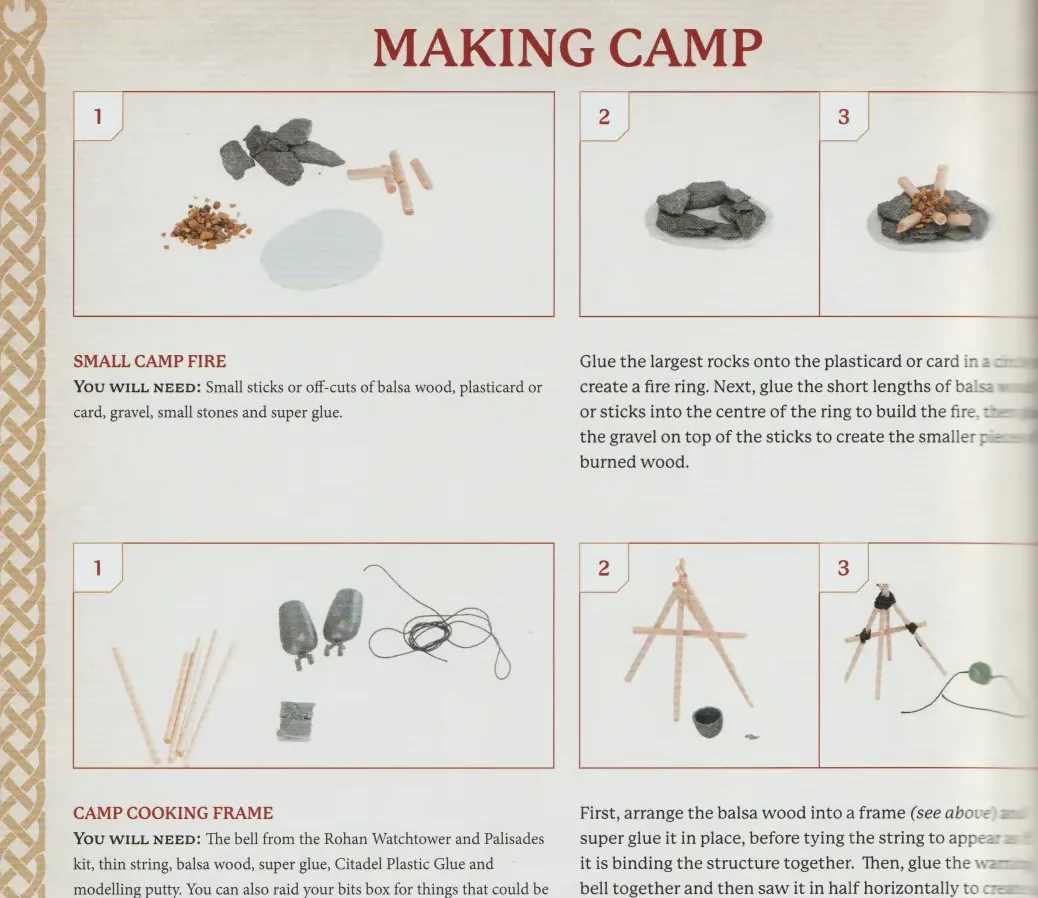
Obviously it's all content you can find on the Internet, but it's nice to see a clean and clear guide in a book that you can lay out on your hobby desk and refer to without constantly pausing and unpausing a video. Also, if your hobby afternoons are intended to be an afternoon away from technology, then crafting guides in a book are a great help.
Perfect campaign book
Middle-Earth Strategy Battle Game (second edition) is basically a perfect game. It's a clean rule set that strongly expresses its setting, and it's a real pleasure to play. Appropriately, War of the Rohirrim is a perfect campaign book. It may even be better, through no fault of their own, than the canonical campaign books (like Quest of the Ringbearer). Campaigns around the canonical events in The Hobbit and Lord of the Rings can get pretty specific, but War of the Rohirrim is pretty generic when you reduce its plot down to a series of battles. The story you have to work with is basically some army fights another army, and the occasional hero has a nemesis. That's really easy to adapt for your miniature collection.
I'm glad I got the War of the Rohirrim campaign book, and I'll likely play several of the scenarios several more times, both as do-overs with the same characters, and as variations using different characters entirely. It's a multiverse out there, so the War of the Rohirrim can be eternal.
If you're a Middle-earth Strategy Battle Game player, then I highly recommend War of the Rohirrim. Even if you're not, I could see reason enough to adapt this campaign for some other fantasy wargame. It might take a lot of work to adapt the special rules in each scenario, but it could be good if you're a fan of homebrew rules and fun campaigns.
All images by Games Workshop, and used for demonstration.