Apparently a company called Rebellion Unplugged has purchased the name Tunnels & Trolls and is raising funds on Kickstarter for a brand new edition of the world's second-oldest tabletop RPG. As I recall, I was introduced to Tunnels & Trolls on a Free RPG Day back in 2007-ish, and quickly adopted it as my go-to solo RPG. It felt a lot like Fighting Fantasy or Lone Wolf, and I spend hours on camping trips and lazy afternoons playing through T&T adventures by myself. T&T has famously fostered a solo RPG system since its beginning, partly because the game uses simple opposed rolls for conflict resolution, and also the game's publisher, Flying Buffalo, released and supported several solo adventures (which fostered lots of third-party solo adventures.) I don't feel like I personally need a new edition of T&T, but the most recent rulebook was printed in 2015 and I reluctantly have to admit that rulebooks can start to look and read a little stale after a decade. This is my review of the Tunnels & Trolls: A New Age Quickstart (beta).
Where's Liz?
You're not supposed to judge a book by its cover, or an RPG by its art assets, but then again the art is often the first thing you notice about an RPG book. Noticing art doesn't require the same number of mental cycles as it takes to read words and comprehend their relative meanings. You notice art whether your brain is "on" or not. The first thing a longtime player of T&T is bound to notice about A New Age is the glaring absence of Liz Danforth.
Liz Danforth's illustrations appear throughout the history of T&T. She edited 5th edition and is credited as a co-author, along with Ken St Andre and James "Bear" Peters, for Deluxe Tunnels & Trolls.
If you don't know her from T&T, then you may know her from a smattering of classic Magic: The Gathering cards, including ones so classic they're names are single words Rust, Shrink, Portent, and Hanna for the Vanguard format (sort of a Commander before Commander existed.)
To me, T&T doesn't really feel like T&T without Liz Danforth, any more than MTG feels like MTG without DiTerlizzi (...and Danforth.)
However, you're not supposed to judge a book by its cover. And yet, I can't help but feel that this new edition assumes people are judging it by its cover. The art style is obviously "modern" (for 2026), and it ought to appeal to a "modern" audience. It looks good. It's great. It's just not Danforth.
Maybe it's good not to be Danforth. If the goal is to separate A New Age from books that might seem dated, then a fresh take on the game's art makes sense. I assume that's partly the purpose of the new edition. Use a name that you can trace back to the 1970s while presenting material that feels like the 2020s.
Job done, I think.
The rulebook is written clearly
I'm a big fan of documentation. Good documentation is like good communication. It conveys intent, instruction, and provides the opportunity for consent.
Classic T&T arguably is not great at communication. I challenge you to find step by step instructions on how to run combat in classic T&T. The steps are certainly there, but it's described rather than dictated.
A New Age gives you exactly the steps you must take:
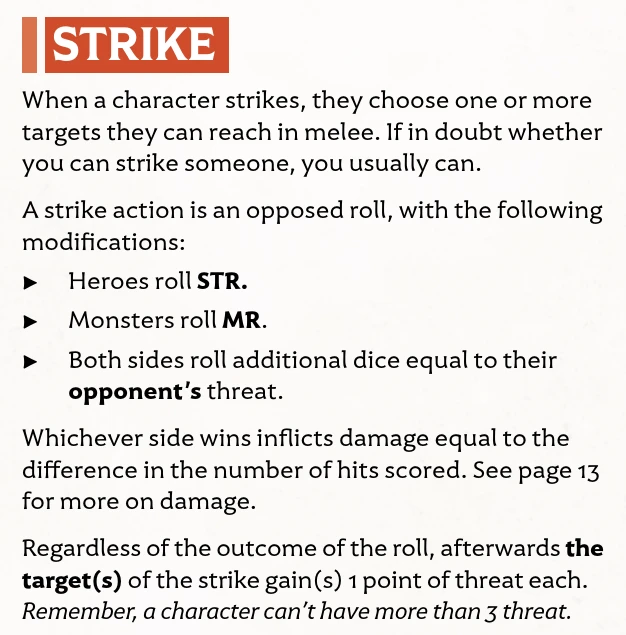
Confusingly, these step-by-step instructions are provided in the Actions section and not the Fighting section, but that's because a Strike is not the only way to fight (you could also use a Shoot action for ranged combat.) So the information is there, it's easy to reference quickly, and the core game mechanic looks (and I do mean "looks") familiar to an experienced T&T player.
In other words, I don't think there's any question that A New Age features superiour writing for conveying game rules. It's declarative and imperative. It dictates rather than describes. It uses clearly defined keywords, and those keywords permeate the rules, providing clean interactions between game subsystems.
Core mechanics remain in spirit but differ in the details
You can accuse lots of games of being variants of D&D, but Tunnels & Trolls stands apart. Its first edition explicitly identifies itself as a do-over of D&D. But it's purposefully a different game, and there's almost a sense that it's D&D done right. Personally, I agree in a technical sense. The writing for first edition T&T is a vast improvement on early rulebooks for D&D, and the mechanics are cleaner, too.
The mechanics of T&T have remained unchanged since its first edition, although the details around them have shifted. For example, for a while magic had a potential negative effect to the spellcaster (pending a Saving Roll) but eventually that rule fell out of favour. The process of casting magic, however, remained the same.
Broadly, classic T&T is a dice pool game using six-sided dice (d6). You're usually rolling against something, whether it's an opposed dice roll or some Saving Roll target.
There are certainly modifiers to your rolls (especially with the personal Adds system that high attributes provide, and bonuses from Talents), but generally your Prime Attributes are influences rather than providers of direct modifiers, or at least they feel that way. For example, it's a Prime Attribute that determines whether you can cast magic or wield a specific weapon, but it does nothing for the way you roll. Your Prime Attribute reduces the difficulty of a Saving Roll before you throw any dice (unless you do the maths the other way, in which case you add your Attribute to your roll and compare it to the SR Level.)
It's all math at the end of the day, but the psychology is uniquely T&T. Attributes are aptitudes, and determine your life path. Talents give you an advantage in specific situations. You challenge an enemy with basically the same resources (a dice pool.) You roll against fate using a combination of aptitude and random chance.
A New Age is also a dice pool system, but it changes what you do with the dice pool. In classic, you take the sum of your roll, but in A New Age you're looking for hits (4, 5, 6) and misses (1, 2, 3). The end numbers, obviously, end up being a lot smaller. In classic 3d6 ranges from 3 to 18, while in A New Age 3d6 produces the range 1 to 3 (not accounting for "exploding dice.")
Deluxe Tunnels & Trolls admits that the great debate of how to generate random numbers is not likely to ever be resolved, even within the T&T team. It even includes notes from 2 of the authors:
KEN: In my view, the game of T&T is about heroes, freaks, and monsters, so exceptional dice rolls are expected. That is perhaps an over-reaction to the people who want to just multiply all die rolls by 3.5 as the dead average. Let’s say you have 15d6 weapon for your troll. The people who use averages say it does 46 or 47 points of combat damage every time. No it doesn’t. It does between 15 and 90 points of combat damage every time.
LIZ: While factually true, that ignores statistical reality. With 15 dice (or even less), the bell curve is going to be so narrow, it is nearly a straight line. You might indeed get 15 or 90, but one person could roll dice until the heat death of the universe and never see either extreme.
In other words, there is not just precedence, but official allowance for alternate methods of rolling, in T&T. A New Age stays true to the spirit of T&T while accepting the invitation to change how dice are interpreted.
Combat
In classic T&T, combat goes like this:
- As a player, you roll a number of dice provided by your weapon (a short sward, for example, grants you 3d6) and add the results.
- The game master rolls for the monster, and adds the results.
- The highest sum wins. Subtract the losing roll from the winning roll and apply the remainder (modulo) as damage to the loser.
There's no armour class (AC) in T&T, so you never target a specific number to hit during combat. This combat loop hasn't changed since first edition.
In A New Age the loop is similar:
- As a player, roll a number of dice equal to your STR, and tally the number of Hits.
- The game master rolls for the monster, and tallies the number of Hits.
- The highest tally wins. Subtract the losing roll from the winning roll and apply that remainder (modulo) as damage to the loser.
It's basically the same, except the hero's dice pool is determined by the relevant Attribute score. There's also a subsystem that awards Threat points, representing the build-up of adrenaline or rage or similar.
Personally, I find the new system appealing. Smaller numbers often feel cleaner, especially within a d6 system (smaller dice ought to produce smaller numbers, right?) and when it comes to damage. I know it's trivial to reduce big-sounding numbers to something small (maybe 55 damage actually represents .55 ml of blood loss, hardly a scratch!) but when I'm counting down Wounds or Health Points, I find it easier to conceptualise 1 Hit as 1 puncture or 1 bone crack. The ability to withstand relatively few of these feels realistic to me (and yes, I'm also aware that I'm complaining about realism in a game where magic and trolls exist.)
Saving rolls
A Saving Roll (SR) in classic T&T are technically as arbitrary as the Difficulty Class (DC) of D&D, except that the game master of T&T doesn't invent a number for the player to roll against. Instead, the game master declares a level for the Saving Roll, which ultimately translates into a target number. Here's how it works:
- Subtract your attribute value from the saving roll level, to a minimum of 4. This is your target.
- Roll 2d6 and add up the roll results.
- If the sum equals your target number or greater, then you succeed.
Really simple, for both player and game master. I find assigning SR Levels in T&T a little more comfortable than coming up with a DC in D&D, although I admit the difference is superficial. The small level of abstraction in SR Levels means I don't have to pre-calculate the actual number I'm demanding of the player, and assigning a "level of difficulty" seems more broad than assigning an actual target number to it. It's superficial, and it doesn't fix the system for me. I still prefer players rolling against their own stats, but T&T ain't Call of Cthulhu.
In A New Age, Saving Rolls follow the same pattern:
- The game master sets a Target Number (TN) 1 to 5.
- The player rolls a number of dice equal to the Save attribute (STR, DEX, and so on). As usual, 1 to 3 is a miss, and 4 to 6 is a hit.
- Tally your hits. If the tally equals or exceeds the Target Number, then you succeed.
It's the same, but different. In classic T&T, your attribute is a firm measurement of your proficiency. In A New Age, your attribute represents how likely it is that you'll be proficient at any given moment.
Both require dice rolls so there's a random element no matter what, but the way randomness is presented has a psychological effect on the player. Suppose your character was STR 13 in classic T&T, and you spent some Adventure Points for a Talent you call Steadfast, for a +3 to resist forces that attempt to push or pull or otherwise forcefully displace you. That's 16 points in a Saving Roll (SR), no matter what. If you're up against a Level 1 SR, then you're almost sure to succeed. You feel good about it, going in.
But in A New Age, your STR is a number of dice. It's easy to imagine that you'll roll under 4 on 3 or even 6 dice. That's a possibility, and ever result is binary: It is either a failure or a success. It's harder to imagine in classic that you could roll 2d6 and not bridge the gap between your Attribute and the SR Level. Even if one dice rolls low, there's the other one that's sure to roll average or above, and the combination of those numbers equal success!
None of that's true, really. It's still all up to chance (I haven't calculated the probability.) But psychologically, classic feels like it emboldens while A New Age feels very much like you're just trusting in fate.
Both systems work, they just feel different. The advantage to A New Age is that the calculation is simple, it happens up front, and every boost has a physical representation (in the form of a dice pool.) That's easier for many players to conceptualise than the simple classic formula of (Level × 5) + 15 - Attribute compared to 2d6, or (Level × 5) + 15 compared to Attribute + 2d6 (if you don't care for subtraction) .
Is A New Age still Tunnels & Trolls?
By the looks of the beta Quickstart rules, A New Age does an excellent job of retaining familiar mechanics (dice pool, opposed rolls, quick resolution) while also defining the processes clearly. I don't know whether I'll play A New Age. I don't feel a need for it, but then again I admire clarity and consistency.
The 2015 release of Deluxe T&T book spends as many pages on character creation as A New Age uses to relay all game rules. A full half of A New Age Quickstart is a sample adventure, and the entire booklet is a mere 42 pages long. The Kickstarter's not for nothing, of course, so inevitably the final rulebook will be a lot longer and a lot more verbose, for better or for worse, but I think it's impressive to see such a clean expression of a game.
To be honest, I'd prefer a Kickstarter that proposed to take the Deluxe T&T rules and codify them with modern clarity. No changes, just a new and minimal write-up of how the game works. Past T&T rulebooks contain a lot of meandering thoughts by the authors about why they've designed the game this way or that way, and how you might prefer to do things, and so on. It's an interesting read, I guess, but when you're just trying to look up a rule it's painful. Frustratingly, because T&T does not have an open license, there's not strictly a legal way to publish cheatsheets or alternate expressions of the rules. So all we've got are the rules as described by a select few brains. I've created my own cheatsheets for personal use, but it's frustrating to have the authoritative rules reference locked inside pages and pages of prose.
If you're looking for a clean expression of the modified version of T&T, join the Kickstarter and hope for the best. All I can say is that the beta Quickstart rules may not contain the exact rules I want, but it definitely contains rules that are clean and clear. Pick your poison. Either way, you'll be slaying trolls in no time.
Header photo by Intricate Explorer using the Unsplash License.