I read All Must End, a short story by Gav Thorpe set in the Warhammer 40,000 universe, and this is my review of it. There are no spoilers beyond what's revealed in common online summaries of the story. If that's too much spoiler, then my totally spoiler-free recommendation is: All Must End is a good short story (well worth the read) that reveals much about the 40k setting by an uncomfortably close examination of knowledge about the setting that many fans take for granted. Minor spoilers in the review that follows.
All Must End is about a Librarian named Harahel, of the Dark Angels chapter of the Imperial space marines. It seems that Harahel has been tasked with investigating a planet that seems to be under attack by the Death Guard, an evil legion of Chaos Space Marines who worship the god Nurgle, the bringer of plague and disease and rot. It's not explained why this is, but for whatever reason Harahel is investigating the world through psychic projection. The problem is, psychic power is really dangerous in the 40k setting, so much so that some space marine chapters (like the Space Wolves and Black Templars) don't even allow psykers within their ranks. At the start of the story, that's the setup though, and so we must assume that all benefits and risks have been weighed, and it's been decided that the best recourse is for Harahel to project his soul across the void of space to investigate the fate of a planet under attack.
This is an interesting story topic because most of it takes place, essentially, on the astral plane. It's an out-of-body experience that takes maybe a minute of [in-world] real-time. Librariar Harahel closes his eyes, utters a few words, Asmodai points his bolter at the Librarian's head, Sammael cautions him to be patient, and then [redacted]. But in this narrative, we accompany Harahel on his astral journey. We experience what he experiences, and so it takes pages and pages of text, countless points of temptations and decisions. It's exploration, it's a struggle, it's a fight for survival. It's maybe not as physically exciting as a story about a space marine clashing chainsword with a chaos daemon's claws, but it's as tense, and in some surprising ways.
The allure of natural
If you'd told me, years ago before I knew anything about Warhammer, that one of the easiest "sells" in 40k is a god of disease, plague, and rot, characterised by puss and boils and decay, I wouldn't have believed you. And yet, somehow Nurgle is an easy fan favourite, and while I don't currently own any miniatures aligned with Nurgle, I have to admit he's hard not to love (Ku'Gath the Plaguefather from Godblight is one of the most likable and endearing characters in possibly all of 40k.)
In this story, Harahel is tempted by Nurgle with one simple (and titular) truth: All must end. It's undeniable that nothing is eternal, even the Astartes, even the Emperor of Man. Harahel imagines what it would be like to surrender at last from the struggle against the inevitable. Why bother fighting to keep mortals alive, when mortals most of all are subject to the entropy of the universe? The most surprising realisation of Harahel's journey is that fighting decay is in fact an act of selfishness. Nurgle preaches that the sacrifice of your inherently decaying body, as food for developing life, is the only true act of nobility.
Nurgle's message is bizarrely alluring, a kind of sublime self-defeating defeatism. Give your life for more life which in turn must also decay. It's only the renewal that counts. In the brief moment where decay becomes the fertile garden for new life, there's a kind of quantum eternity where life is persistent. Life encompasses decay, so if you fight the ending of life you're acting against the natural order of the universe.
The thing about the Warp is that it has infinite capacity for deception. We don't have, at least as far as I know, any reason to believe that Nurgle's ultimate goal is anything but preserving the natural cycle of life. But Nurgle is a power of the Warp. It's hard to trust the Warp, and I can't help but wonder whether Nurgle might be nothing more than a mask of an even greater and older entity, with motives that have nothing to do with renewal and perpetual life. That's just me, though. According to Warhammer 40,000 lore, we take Nurgle at his word. He's a god of disease only because disease is a form of life, and all he wants is a vibrant and thriving garden of life. How can Harahel refuse Nurgle?
That's the really brilliant angle this book takes while presenting a battle of wills between Nurgle, a force of Chaos, and the son of [a son of] the Emperor. It's the conflict that frankly the wargame, at least in its 10th edition, doesn't make an allowance for. Aside from the Leadership attribute, there's no Save against charisma in 10th edition Warhammer 40,000. But in All Must End, we get to witness the Intelligence saves of Harahel's discipline against Nurgles's charm.
Teamwork
Aside from Harahel's own mental fortitude, we're also reminded of what a Chaplain actually does in a Space Marines chapter. I've seen Chaplains in Angels of Death and Blood of Iax, but Sammael in this story is probably the best introduction to the role of a Chaplain I've seen so far. In 40k, most of the space marines don't revere the Emperor as a god. First of all, the Emperor explicitly told the Primarchs that there are no gods, and secondly the Emperor is basically their grandfather. And yet most chapters have a Chaplain role, which can be confusing if you try to process it using real-world analogies. A Chaplain in a real-world military is a, usually ecumenical, priest in Christianity. That doesn't generally translate to 40k, because the Chaplains there are not a part of the Ministorum and the Imperial Cult. Instead, a Chaplain looks after the spiritual well-being of his chapter, which may not involve the Emperor at all. What it probably involves, as often as it needs to, is resistance to the temptations of Chaos.
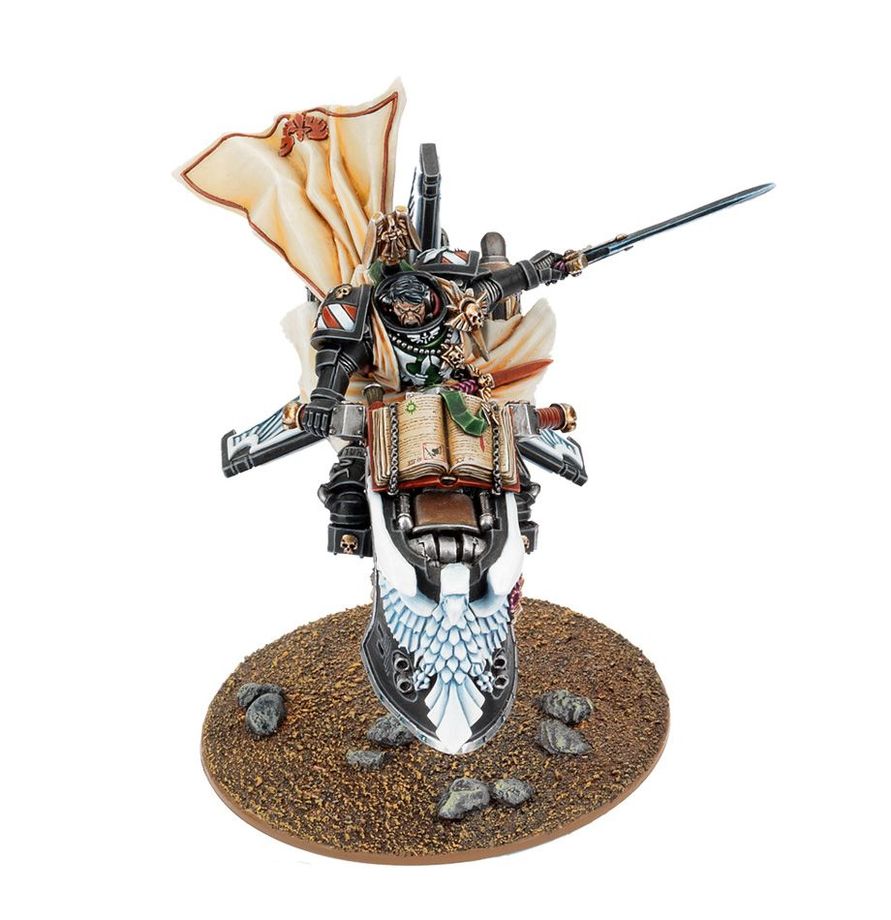
In this story, it's Sammael who literally saves Harahel's life when the psyker starts mumbling seemingly incomprehensible descriptions of a world torn asunder by plague. Asmodai wants to put a bolter into Harahel's brain immediately, but Sammael stays his hand, and helps Harahel find his focus with just a whisper. It's one of those moments where you suddenly realise you only now understand what all those Chaplain miniatures you've fought with actually did (aside from looking like the coolest miniature on the table.) It's a good moment in the fiction, but if you play then it's that much better.
Good Warhammer
This was a good short story, emphasising that the battle for mankind doesn't always happen in real space. The 40k battlefield extends into the unseen and into the timeless, and I think that sometimes does come through in games, if you let it. Those times when an enemy psyker buffs its army might be annoying for you as you roll dice against them, but it's even worse if you pause to think about why your army is suddenly less effective than usual. It's not just a penalty to a roll, it's that the willpower of your troops has been worn down by Warp energies, causing them to fire weapons with less proficiency, or to stand instead of charge. In other words, this is a great read on its own, and an even better read as a reminder of the unseen forces at play at your wargaming table.
All images in this post copyright Games Workshop.