The game Titanic Duel was released in White Dwarf 523, and it enables you to pit two great battle mechs against one another on your tabletop. I have a Knight Questoris model from Games Workshop, and I've used in in some games but, appropriately, it usually dominates the battlefield so I don't use it often. I was happy to see a game written especially for the big stompy robots of the Imperial Knights faction, but I admit I had doubts whether it could be done in an interesting way. A duel in a wargame is a difficult thing to make interesting, because it usually ends up being two miniatures standing toe to toe while the players roll dice in hopes of putting an end to their boredom. That's fully what I expected from a game with just 2 battle mechs on a tabletop, but Titanic Duel has some interesting ways of encouraging actual tactics to keep the game tense and fun.
I only own one Knight model. These are big models. Mine stands 19 cm (8 or 9 inches). White Dwarf issue 523 says they'll be releasing datasheets for other knights, but I don't know whether that includes the small Armigers, of which I have several. Lacking really big stompy robots, I decided to use small stompy robots instead, and played this game (with modified movement and weapon ranges) with my BattleTech miniatures.
Game play
They game's rules are maybe 2 or 3 pages, and much of that is formality defining the meaning of a re-roll and that sort of thing. The game is really simple (which is part of what concerned me.)
On your turn, you get 3 Action Points. You have 7 actions to choose from, but some actions cost more action points than others. You can:
- Snap attack (1 action point)
- Advance move (1 action point)
- Run move (1 action point)
- Standard attack (2 action points)
- Charge (2 action points)
- Aimed attack (3 action points)
- Unique action (variable)
Because there's an economy of actions, you're forced to weigh the potential benefits of precision. With an aimed attack, you're more likely to hit your target, but then that's all you get to do. Maybe a standard action and a move is good enough? Or maybe your Knight is kitted out for melee anyway, and so what you really want to do is run or charge to get yourself close enough for close quarters combat. But how do you get the benefits of an aimed attack in melee when your target keeps moving?
Targeting subsystem
Action points keep you thinking, but the targeting system is really the star of the game. In the back of White Dwarf, there are cardstock datasheets for a typical Knight. There are numbers on the different major areas of the Knight chassis, so when you make an attack you announce what number you're targeting.
Then you roll 2d6, one to provide your accuracy on the horizontal plane and the other for your accuracy on the vertical plane.
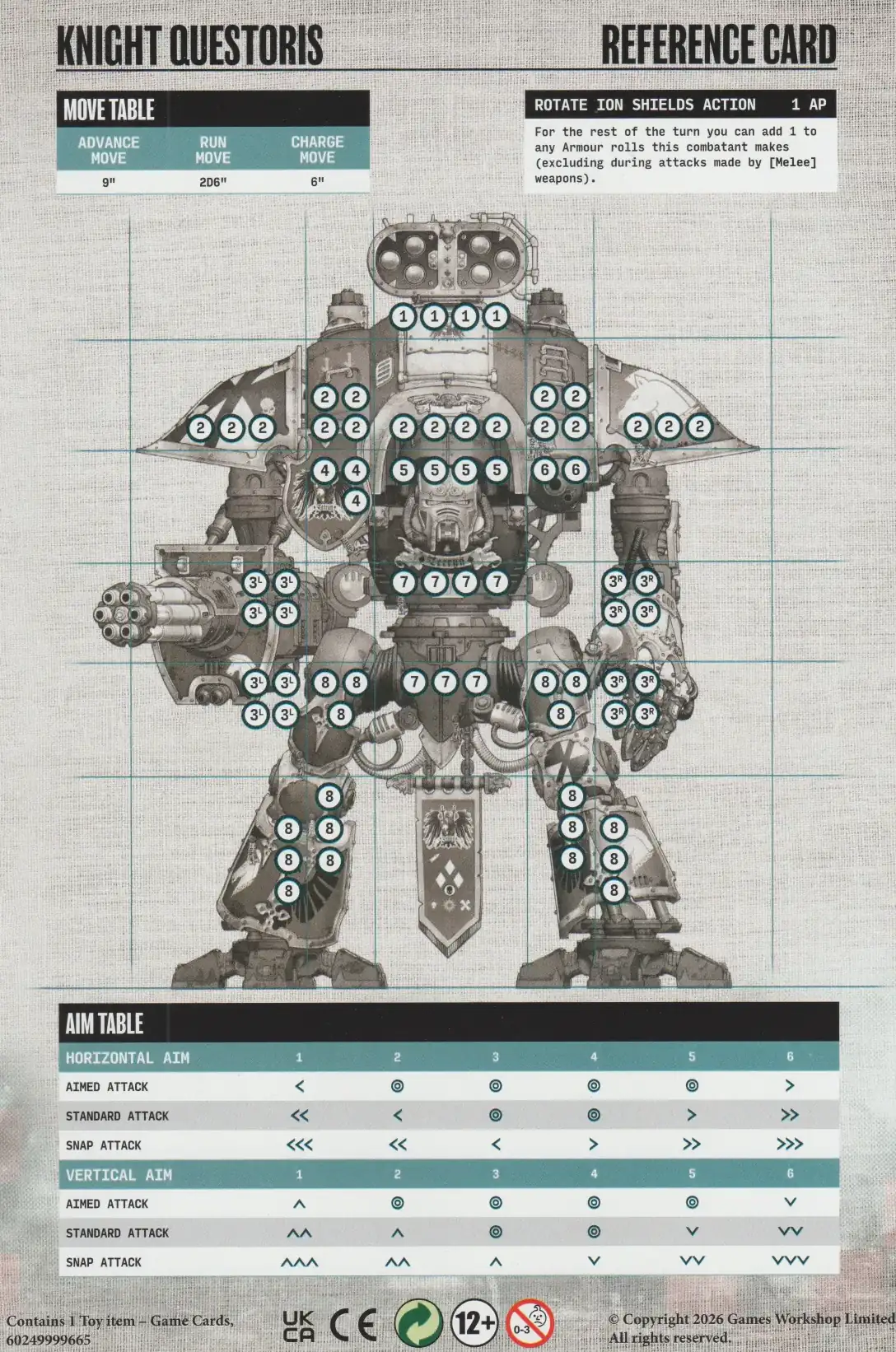
Finally, you consult the Aim Table table to see what your roll result means for your targeting. If you rolled poorly, then there's some drift, or your opponent has had time to react, and the Aim Table tells you which way along the horizontal and vertical axis you must move to find out where your attack actually landed.
There's some strategy to focusing Snap and Standard attacks at the body core, in hopes of mitigating drift, and Aimed attacks at the extremities. That doesn't always work, and I've definitely targeted the head (which on a Knight is in the centre of the body casing) and shot right over the Knight's shoulder instead. Rolling a 1 or a 6 on a Snap Attack renders the absolute worst results (3 drift, which usually is enough to hit nothing). You can try to second guess fate and aim for an extremity with a Snap attack, but you quickly learn that you're just as likely to drift out than in.
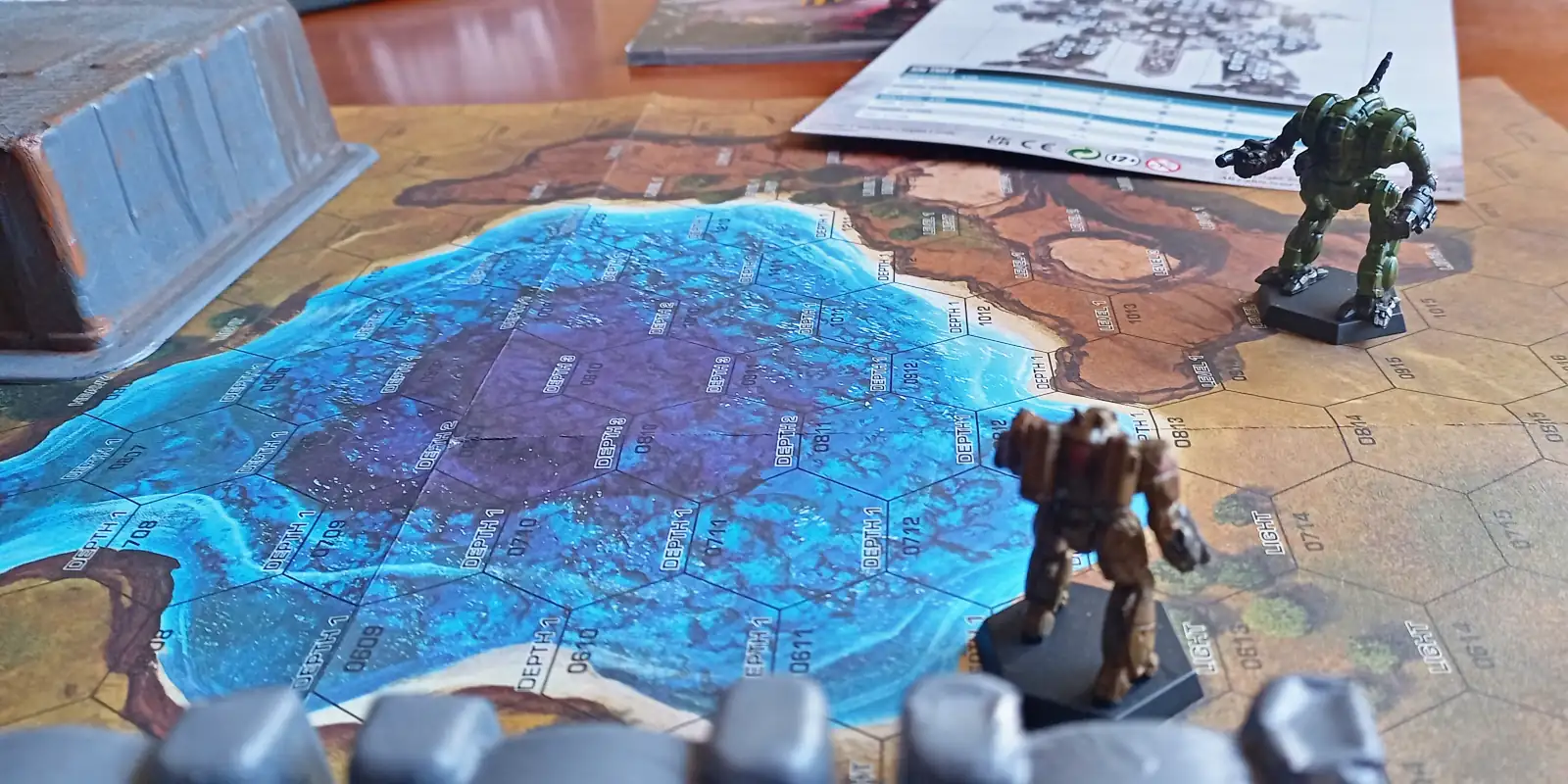
It's a really clever system that makes the game feel a lot more tactical than, I guess, it actually is. It's exactly the kind of rules referencing that makes you feel like you're making complex calculations, as you would while piloting a battle mech, but that's actually easier than even calculating wounds in Warhammer 40,000. In fact, there are basically no armour values in Titanic Duel, much less Strength and Toughness values. The only saving roll you make is a straight d6 roll, which you often forego anyway because the armour penetration of the hit makes a save impossible. The dice rolls in this game are some of the simplest dice rolls I've seen in a 40k game, and it makes running the game really really simple.
It's all about tactics
Simple dice rolls doesn't mean the game itself is easy to win. A common problem with tabletop wargames, and real life I guess, is that once you take a loss, you find yourself less and less likely to win as your disadvantages compound. Luckily, an Imperial Knight is well stocked. You can lose access to most of your weapons and still score some key hits with Aimed attacks for a win.
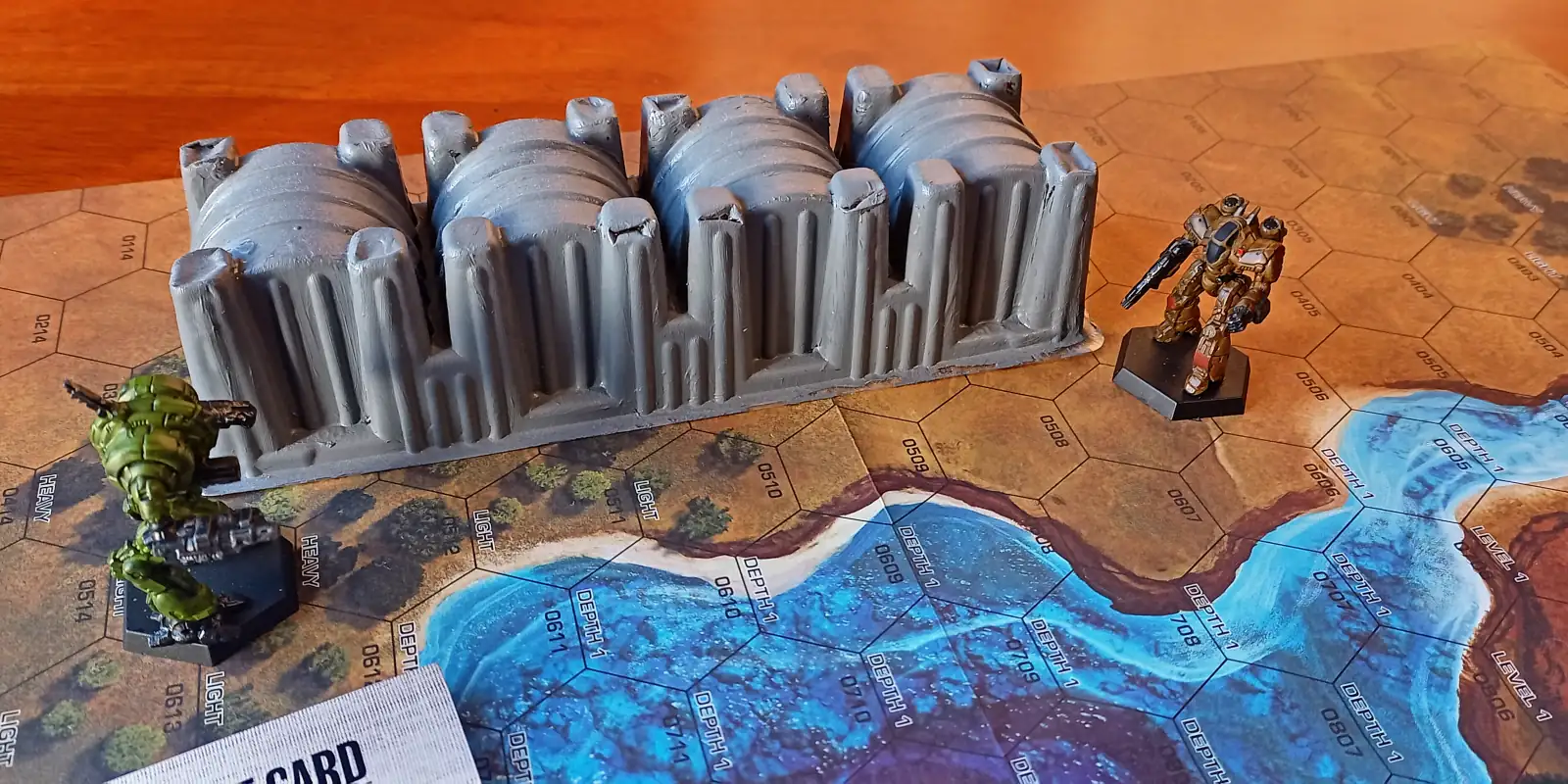
Playing a melee mech against a mech with ranged attacks makes for a very interesting game even if you have no terrain. I crafted some buildings for my battlefield, and that made for an especially fun game no matter what combination of mechs were going to battle. There are rules for cover, so spending 2 Action Points to run for cover sometimes saves your life.
Good mech battle game
I play most content in each issue of White Dwarf I get, and if there's one thing I've learned about game content in White Dwarf is that it's barely playtested and basically not edited. True to form, Titanic Duel leaves some important elements undefined. For example, a Charge action means you can move and then attack. But there are 3 different kinds of attacks in this game (Snap, Standard, and Aimed) and the rules fail to specify what kind of attack is included in your Charge.
There's also a hilariously minimal one-page "battle report" in White Dwarf 523 that I think drastically under-sells the game. The brevity of the battle report makes it seem like they didn't have enough content to generate an actual battle report, but if nothing a game of Titanic Duel has too much in it. I don't play with the full number of wounds provided on the datasheet, and instead score each region as destroyed after 1 successful hit. It makes for a quick game, but you could just as easily play with 2 wounds in each region, or 3, or whatever pace is right for you.
As long as you're willing to improvise when rules are unclear or when the pacing is off, Titanic Duel is a very fun game for some of the biggest models available in the Warhammer 40,000 line.