I love a game that's both a good experience and an invitation for expansion. A game that provides an experience that extends outside its own box is, in my opinion, the pinnacle of good product design. The HeroQuest board game, with its recent re-release, encapsulates the ability of a humble board game to both be strictly defined by its board and playing pieces while also allowing for infinite re-playability through custom scenarios. In fact, I think HeroQuest is the perfect example of a game framework, and it's a game that probably everyone should own.
HeroQuest was designed by Stephen Baker whilst working for Milton Bradley and in cooperation with his former employer, Games Workshop. It was released in 1989 so, whether or not you've played it, you probably remember TV and magazine adverts if you were a child of the 1980s or 1990s. The game mechanics are simple, and heavily influenced by wargaming and roleplaying games. All but 1 player takes on the role of a hero (a barbarian, wizard, elf, or dwarf) and moves through the halls of a dungeon, kicking down doors toslay monsters and collect treasure. The remaining player assumes the role of Morcar (renamed Zargon, in the USA release), an evil wizard and master of the dungeon and nemesis to the player characters. Players roll dice to move, and when in combat they roll dice or play special ability cards to attack.
If you're a player of DnD, then that probably sounds both simple and familiar. It's a board game, of course, so HeroQuest often plays more like a skirmish wargame than a pen-and-paper roleplaying game. Then again, a dungeon crawl in DnD is often (at least in my games) the time when roleplaying happens the least, because the players are on high alert. We may not be in initiative order, but nevertheless they don't have time for social interaction. They're too busy peering round corners and looking for traps and fighting weird monsters. In other words, HeroQuest may look more like board game than an RPG, but it occupies that space of an RPG that doesn't need more roleplay than HeroQuest requires.
There are 5 elements particularly about HeroQuest that appeal to me, both in terms of design and execution.
1. Board
By now, the HeroQuest board is iconic.
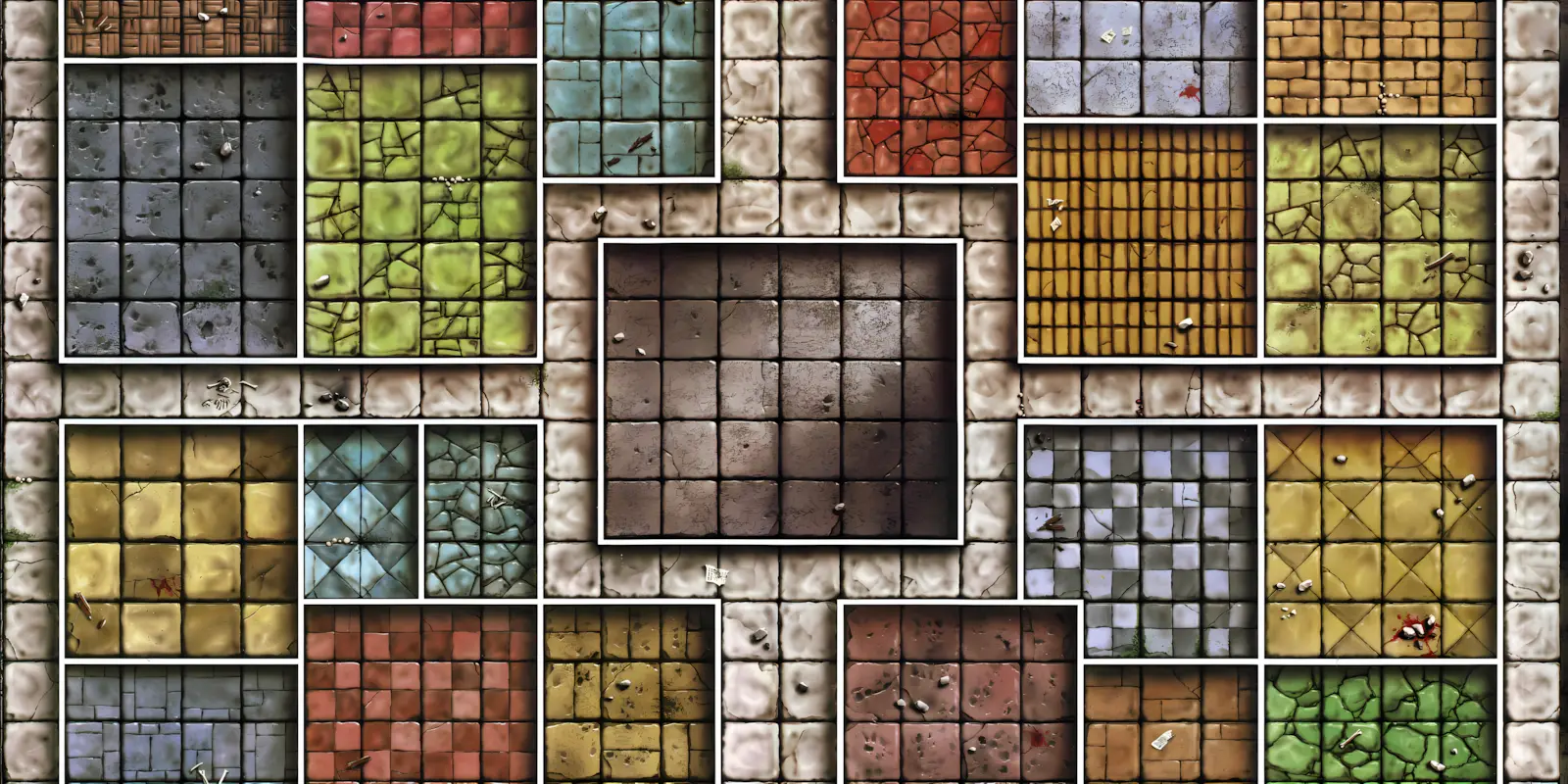
The board is a grid with artwork depicting stone hallways and tiled rooms. Rooms are indistinct and have no door, but Morcar can place a door leading into any room required to build the dungeon.
It's basically an update to the old method of designing dungeons on graph paper. You don't have to draw the dungeon, you just use the rooms you need. There are several quests included in the box, so an inexperienced Morcar learns the basics of designing and populating a dungeon just by playing. After that, Morcar can create custom dungeons, as long as that dungeon fits into the grid.
The great thing about the minimalism of the board design is that it can be almost anything. It's not so abstract that you could convince me it was a jungle, I guess, but I'd accept any structure that's mostly indoors and made of stone and tiles. It could be a temple, a tomb, a lab, a mansion or a castle, an arena, a maze, or a plain old tradional dungeon (a prison, I mean). It's an astounding work of simple art, and I only wish (as I often do, with board games) that it was double-sided. One side could be a stone version, and the other side could be an outdoors version, or stone on one side and wood on the other, or anything to add flexibility to the setting.
The point is that the board is evocative but minimal, and it makes it possible to imagine such a variety of settings that it never gets unbearably repetitive.
2. Miniatures
The re-release of HeroQuest comes with 71 miniatures in the box, which includes player characters, goblins, skeletons, dread knights, and bosses. It's not every creature type you'd ever want, but it's got the essentials, and enough to serve as a broad representation of fantasy monsters.
(I've used the same Mansions of Madness miniature as a towns person, a zombie, and a fishy cultist, so I'm well acquainted with flexible monster types.)
With 71 miniatures, it's easy to build a story around an infestation of mischievous goblins, a necromancer's undead horde, a warlord's raiding army, and much more.
3. Monster stats
Because there are only 4 or 5 creature types, the monster stats of HeroQuest are easily summarized on a single page (which conveniently doubles as a game master screen). The game mechanics are pretty simple, so the stats aren't much more than health points (usually 1 or 2) and number of attacks. After you've played 2 games as Morcar, you're likely to remember the stats without even looking at the reference card.
4. Mechanics
There's a lot to be said for game mechanics that fit in the box they're delivered in. That's not true for all games. Some games are so big and expansive that no matter how much you play it, you're unlikely to ever experience all of it. That's not the case with HeroQuest.
After you've played a dozen games of HeroQuest, you've probably experienced everything it was programmed to offer. You've used the whole of the game board, you've used all 71 miniatures, you've been in combat with every kind of monster, you've played all the cards. Far from being a limitation, that aspect of HeroQuest is one of its greatest strengths.
One common "problem" with wargames and roleplaying games is that player characters can become overwhelmingly powerful. The games master must adapt the threats to be more powerful than the player characters. It's not enough to just make the stat numbers bigger, because all that does is make the game the same, but longer. A clever games master must instead invent new mechanics and puzzles to challenge players in ways that don't involve rolling dice until you get a high number, which is a euphemism for game design.
HeroQuest manages to contain that. With HeroQuest, stats stay the same. There are some big boss monsters you have to fight, and Morcar eventually gains some powerful spells, but those components are all in the box. After the scariest monster has been fought and the most powerful spell has been cast, players have witnessed the upper limit. That's as bad as the HeroQuest world is going to get, and yet the challenge remains the same. No matter how many times you've played the game, monsters are going to attack you and an axe in your cranium is still an axe in your cranium. The heroes of HeroQuest can die, regardless of how far along a campaign they are.
Because the game has so many constants, the variables Morcar introduces through dungeon design and story are all the more meaningful. And so are the special items the heroes find as they explore.
5. Adventure
The most inspiring thing about HeroQuest is that you can still play long after you've played the adventures included in the box. Obviously you can just replay the adventures, but you can also just make up your own campaigns. HeroQuest isn't just a game, it's a whole game system. It's got simple mechanics, plenty of miniatures, doors, and set dressing.
If roleplaying is too free form, and wargaming is too big, then HeroQuest is a perfect solution. Armed with its singular battle mat, a few player characters, and several handfuls of monsters, your dungeon crawls can last forever. You can incorporate as much or as little roleplay as you want, you can create special rules for special scenarios or you can play it by the book. The game loop is addictive, and the implementation is perfect.
The perfect game system
HeroQuest is basically perfect. Strangely, I don't own a copy myself because someone in my gamer group does. It's definitely the game I'd take with me to a desert island, though, for its endless possibilities.