The year 2025 was a good year for White Dwarf magazine. Issues 515 and 516 released Space Marine Operations, a co-op mode for Warhammer 40,000, and I honestly didn't think it could get better than that. But then in November there came issue 518, which at first glance seemed like it would be an issue of self-celebration. Its cover, after all, proclaimed proudly that Games Workshop was turning 50 years old, which is absolutely a Big Deal™. But the more I read, the more I realised that this was as issue that lived up to its parent company's name. Issue 518 was a veritable workshop of game content. I have a lot of White Dwarf issues that I keep close at hand for painting or gaming content, but looking back at the past year I'm realising that issue 518 is probably the issue I've gotten the most use out of yet.
History of Games Workshop
The first 32 pages of issue 518 is a history of Games Workshop. It's a sort of Games Workshop museum tour, and I love a good museum, so this is perfect. I missed out on early Games Workshop because I grew up in the USA, and we mostly knew D&D (although I did manage to stumble onto Lone Wolf and Combat Heroes by Joe Dever.) This little overview wasn't all new to me, because the Internet does exist and I've visited it a few times, but it was nice to get the full story in a tidy timeline along with some obscure topics that the Internet tends to ignore for the sake of SEO (nobody's searching for "Troll Party".)
The Blessed Boltgun
You can thank me for this one. I emailed Games Workshop and the team at White Dwarf a request for an overview of the weapons in 40k, and I simply have to believe that this article (along with the lasgun Loremasters video on Warhammer TV) was written to get me to stop emailing. Hey, whatever it takes.
If you want to learn all about the boltgun, there are 8 pages about it in this issue. I've ready it at least 8 times. It's a great article, with beautiful art in the background and super cool line art to illustrate the finer details about bolt rounds.
Battle through the ages
In the Battle through the ages section, the White Dwarf team provides modern (10th edition) rules for landmark 40k boxed sets. This is such a simple idea, it's almost silly, but actually it's also brilliant. I didn't play 2nd or 3rd or 4th edition, and I very much doubt I'll ever bother trying those rules. I have no nostalgia for them, and I'm happy with 10th edition, so I have no need to experience different rules, but I love playing scenarios. For example, I played Battle at the Farm from Rogue Trader but I didn't play it with 1st edition rules.
In Battle through the ages, you get detachment rules for the 2 factions featured in the boxed sets for 2nd, 3rd, and 4th edition Warhammer 40,000. This means you can grab models and data sheets you own and assemble an army that fits (or nearly fits, depending on your collection) the armies sold in the box. The detachment rules are written complete with enhancements, a unique objective, and stratagems.
- 2nd edition: Space Marines and Orks
- 3rd edition: Space Marines and Drukhari
- 4th edition: Space Marines and Tyranids
A scenario for each boxed set is also provided.
- Ruined Chokepoint (2e): Head-to-head onslaught of orks against marines. The marines are rewarded for standing their ground, and the orks are rewarded for looting objectives.
- Xeno-jungle hunt (3e): Entangling foliage makes for difficult terrain and boosts cover. Space Marines are rewarded for killing xenos, and the xenos are rewarded for grabbing objectives.
- Crashsite Alphus (4e): A tyranid incursion, with lootable terrain. Space Marines are rewarded for staying alive, and the tyranids are rewarded for infiltrating the Space Marine deployment zone.
This is a really fun section of the magazine, and after reading it I was fully satisfied that I'd gotten my money's worth. Another great issue that's paid for itself, in terms of gaming content. And then I turned the page.
Well, actually I turned several pages because there's battle report that's fine, but what's really cool is what came after that.
Wasteland Death Race
Mario Kart on the tabletop.
I've already reviewed and written a battle report for Wasteland Death Race, so I'll keep this brief. Wasteland Death Race is my (pardon me for saying so) Gorka Morka. That's not to say it's anything like Gorka Morka or even as good as it, because I don't know. I missed out on Gorka Morka, but people speak of it fondly, and I imagine it's a whacky and chaotic kind of game. But it's probably not as simple as Wasteland Death Race.
In fact, I don't think many things are as simple, and yet as effective, as Wasteland Death Race (WDR). I'll admit that I don't play many racing games, but I have played a few, and I actually tend to enjoy them. But I think I'd happily give them all up for this game, if I could only choose one. The ratio of rules to enjoyment is really impressive in WDR. Were the rules written without errors, you could learn the game in just a quick read of 5 pages, and only 2 of those contain persistent rules (the other pages provide special effects and build options.) Sadly, the rules were not apparently proofread, so it actually takes a read and a test play or two, but you get the idea instantly, and it's fun from the start.
You do just 2 things on your turn:
- Set your speed
- Move
That's all. Anybody can remember that, but just because it's simple doesn't mean it's easy. The moment you go to set your speed, you understand that there are trade-offs. You can go fast but if you do, you can't turn as quickly (and if you do, you take damage.) You can ram your opponent, but there's risk that it could backfire. You can take damage, but then you have to slow down.
The game is nothing but trade-offs, and depending on the track you've designed for the race, there's never a default strategy. You have to make decisions based on the road and, more likely, on the bad behaviour of your opponents.
Fun game for everyone, and for any model. Race chariots, Goliath Rockgrinders, Leman Russ tanks, Ironstriders, Armiger Helverins, horses, dinosaurs, or whatever else you have on hand.
Hellsmiths of Hashut
After Wasteland Death Race there's a bunch of Age of Sigmar content about chariots, and then lore and painting guides for Hellsmiths of Hashut. This was useful at the time because the free miniature of the month at Warhammer shops was a Hellsmith. It's still good content, and I've been referring to it every now and again when I paint a dwarf miniature.
Black Library
If you're overwhelmed by the number of novels set in the Warhammer universes, this is a really useful section that focuses on the must-read books from Black Library. It might seem weird to take advice from Black Library about what to read, but in this context it's helpful. After all, it doesn't actually matter what you read. You can just pick a Black Library book and start reading. If you're looking for an arbitrary suggestion of where to start, then it doesn't matter whether that recommendation comes from a random person on the Internet (like me) or from the company that publishes the material.
I enjoyed this section because it does take a relatively objective look at the books you ought to read if you're looking to get a good sense for what Black Library puts out. This isn't a best seller list, nor is it a bargain bin listing of stock they need to shift. These are books that either cover a major character or event in the universe, or that serves as the gateway into a larger series. You may not copy all the recommendations here onto your personal reading list, but if nothing else you get a sense for what's out there.
Great issue
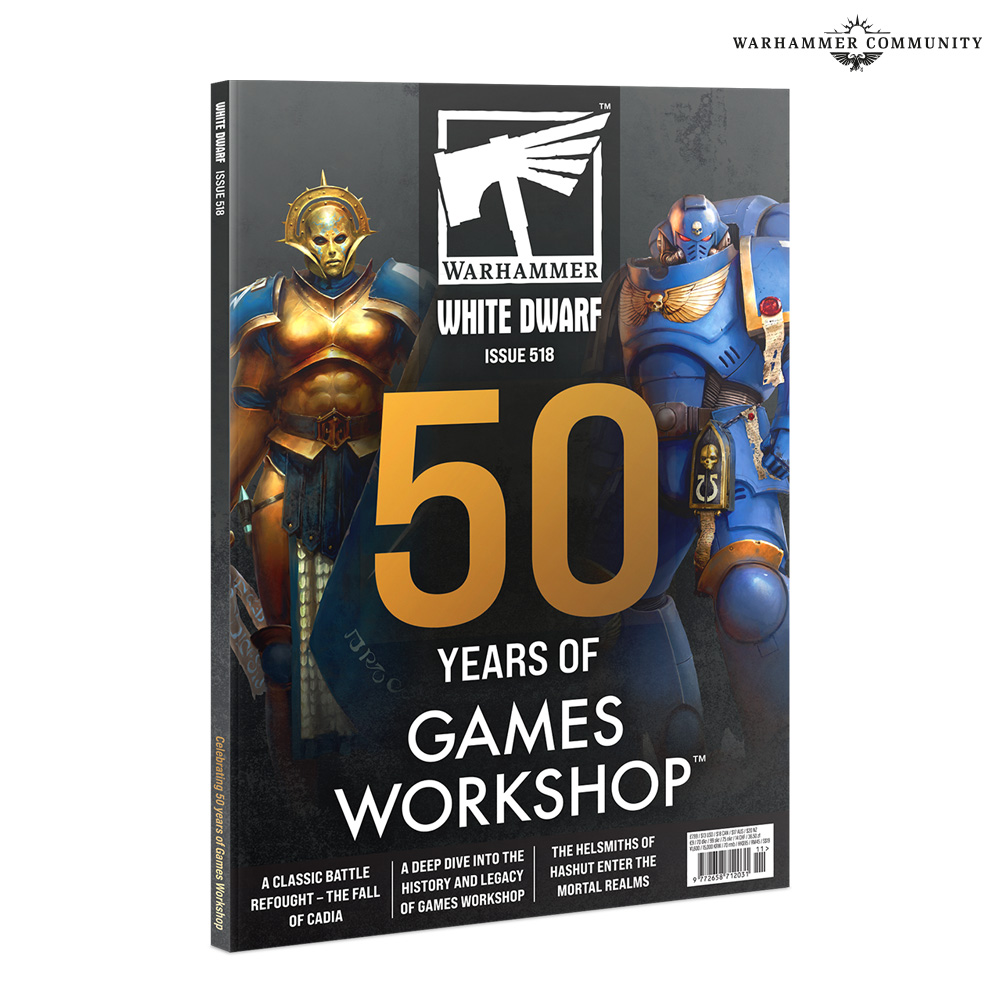
Issue 518 is one of those great issues of White Dwarf that starts out as a normal everyday magazine but eventually ends up in your pile of actual game books. It's not issue 518's fault that it wasn't released as a hardcover or even a boxed set. As 50th anniversary celebrations go, this is pretty satisfying. Great gaming content, lots of lore, and a little bit of guidance on what to investigate next. No complaints. I'll happily continue to leave issue 518 off my bookshelf and close at hand.
All images in this post copyright Games Workshop.