Issue 518 of White Dwarf published a chariot racing expansion for Warhammer: Age of Sigmar called Wasteland Death Race. The game rules are just 3 pages, with 4 pages of chariot and driver build options, and 2 pages for a scenario. I don't really play Age of Sigmar, but the game seems pretty approachable for anybody, and I do have 2 chariots, so I decided to give it a try. This is my review of the game, along with a wee battle report.
The good news is that the rules are really only 2 pages, because the first page is entirely a definition of terms (like "Winning" and "Ahead" and "Behind" and "Neck 'n' Neck" and so on.) The bad news is that they forget to explain some key physical components.
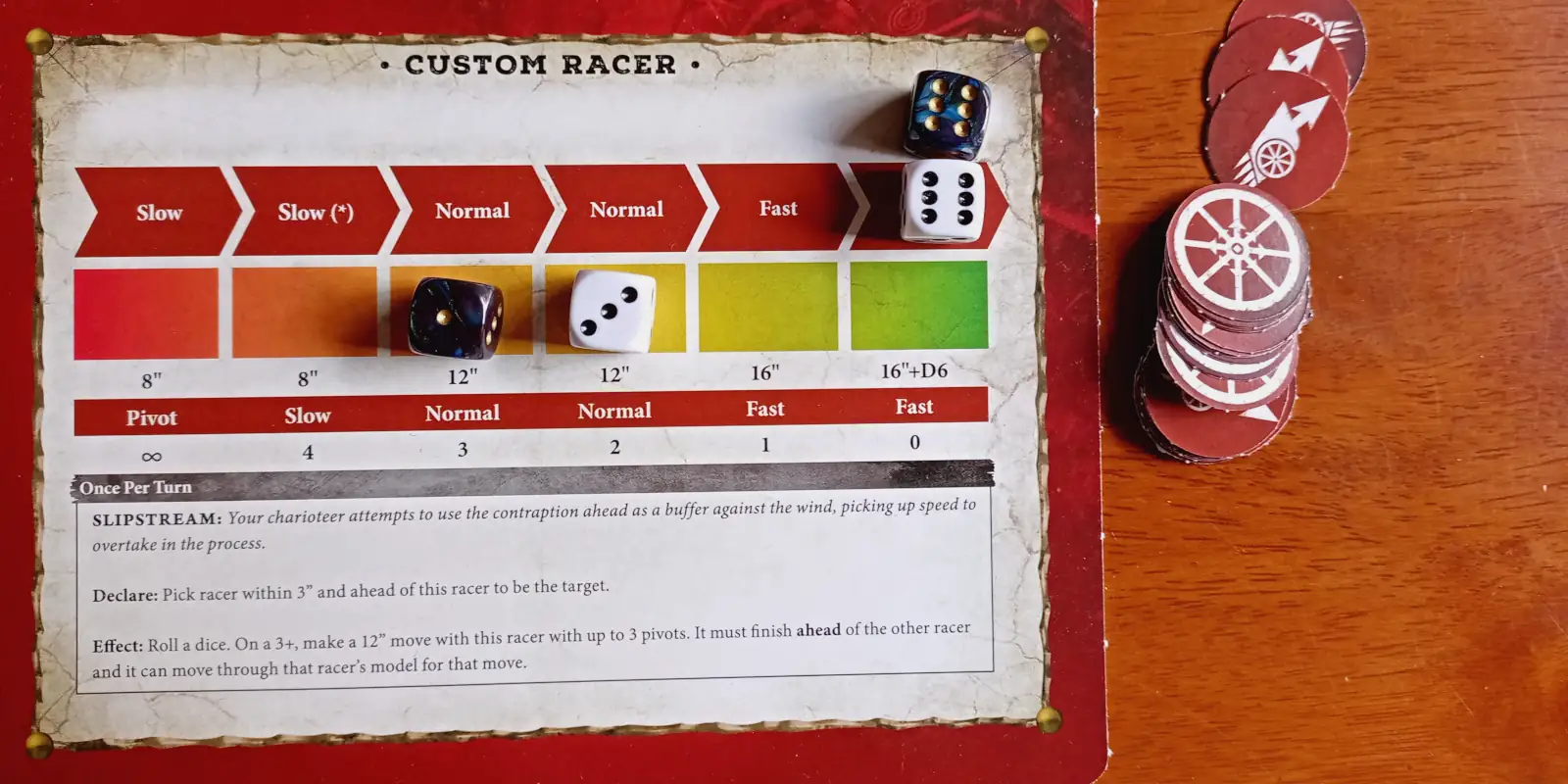
The magazine includes a warscroll card and several tokens of 2 types: A chariot token and a Wheel token. The rules explain that when you speed up or slow down, you move a d6 along one of the tracks on the warscroll, but the rules don't explain the significance of the value on the d6. It does show, in 3 separate graphics, that you're meant to change the value of the dice when they move, but it doesn't establish what value you start with, or what the value means. There's also no mention of the tokens at all. I think one of the token types is meant to represent Artefacts of Power, but I don't know which token, and I still don't know what the other token would represent.
I was still able to play the game, though, or at least some version of it. I sent an email to the White Dwarf team to ask for clarification, but as of this review and battle report, I hadn't heard back (which is fair, because I just sent the email the evening before playing.)
The rules
The chariot furthest from the table edge takes the first turn of the game, and from then on the chariot in the lead goes first. On your turn, you Set Speed and Move.
To Set Speed, you move a d6 along the bottom speed track. Under each space of the speed track there's a number of inches, which tells you how far you can move that turn. However, there's also a Pivot number, which defines how many Pivot actions you can take during your Move.
The 2 graphics that show dice moving along the speed track show the dice incrementing when moving right and decrementing when moving left. As far as I can tell, a d6 is set to 1 when it is in the left most square, and increments by 1 up to 6 on the right. I can't figure out the significance of the value. At first, I guessed that you add that number to the number of inches you can move, but that's stupid (if it can only change by 1 in each direction, just build that into the Movement amount written on the card) and also unlikely because the fastest speed you can go is 16"+D6, which would be 22+D6 if you just automatically add 6 for the dice on the speed track. I treated the dice on the speed track as just a token, and ignored its value entirely.
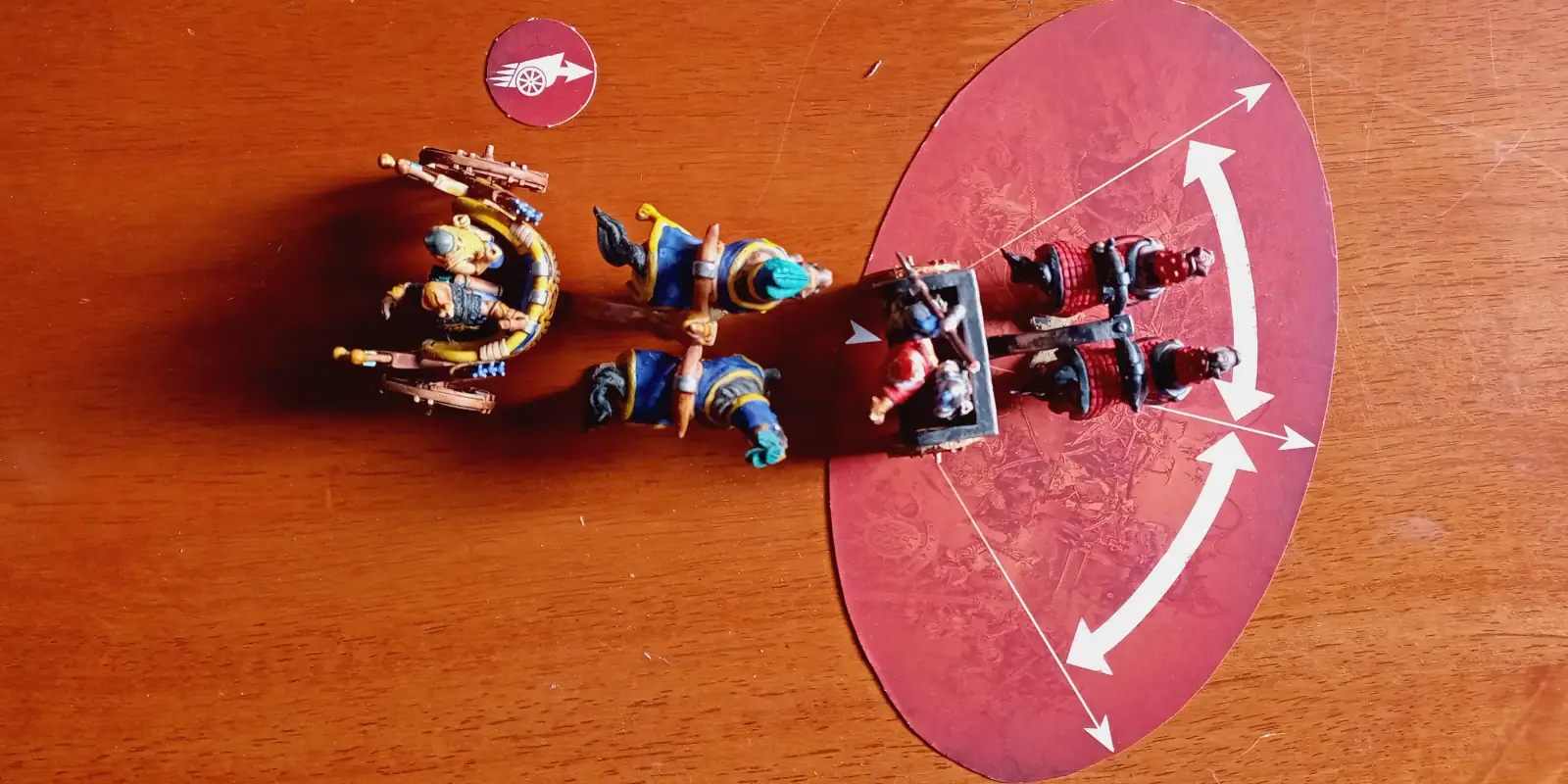
Pivoting is done with a handy template. You place the template under your chariot such that the centre arrow is dead center. For each Pivot your speed allows, your chariot can turn one increment either left or right. This is some beautiful design, and I found myself being too conservative with my speed because I thought I'd need more room to turn, or I'd go too fast and careen off into a tree.
To add to the calculations you have to do while racing, there's only an allowance to speed up or slow down in the rules. You can't stay at your current speed. This is a somewhat counter-intuitive rule but it's surprisingly effective. It forces some hard choices, and encourages you to think 2 or 3 turns ahead, as you try to anticipate how much room to manœuver you're going to need.
In addition to that, there's also the possibility of getting rammed by your opponent, either by accident or malice. For that, you roll off to see who's most affected by the collision, and then roll on a random table to find out what happens. Unfortunately, the lack of any detail on damage makes this pretty confusing. The worst effect is Kerrunch!, which deals 2d3 damage, but there's only the barest indication in the rules for how you're meant to reflect that on your warscroll. Apparently the top track is the damage tracker, and supposedly you can reduce damage by moving your d6 left (slower) along the damage track. But the only graphic illustrating this shows the dice increasing its value when moved left along the damage track, which suggests we're counting up to a maximum level of health. But what's the maximum level of health? I'm guessing probably 6 for any given chariot, but it's not clear to me when that dice is meant to be added to the damage track. Do you put 6 on whatever speed you start at? Or do you always start out slow, and then ramp up and down from there? I don't know how it works.
Before you play, you can build a chariot and its pilot, which can add variation to each game. There are both positive and negative effects (you can take negative effects to earn build points so you can afford a really good positive one,) so you can customise your chariot according to the terrain, the competition, or just according to the way you role play.
The first game
I was excited to try the game because the rules seemed nice and tidy (aside from the parts they forgot to explain.) My initial read was correct: The game is easy to run and really fun to play.
I only have 2 chariots: Muwatalli II of Hattusia and Ramesses II of Egypt. In this alternate timeline, Muwatalli and Ramesses (both the second of their name) decide to settle their differences not in the great Battle of Kadesh but in a more or less civilised chariot race. Egyptians and Hattusians gather round to cheer them on.
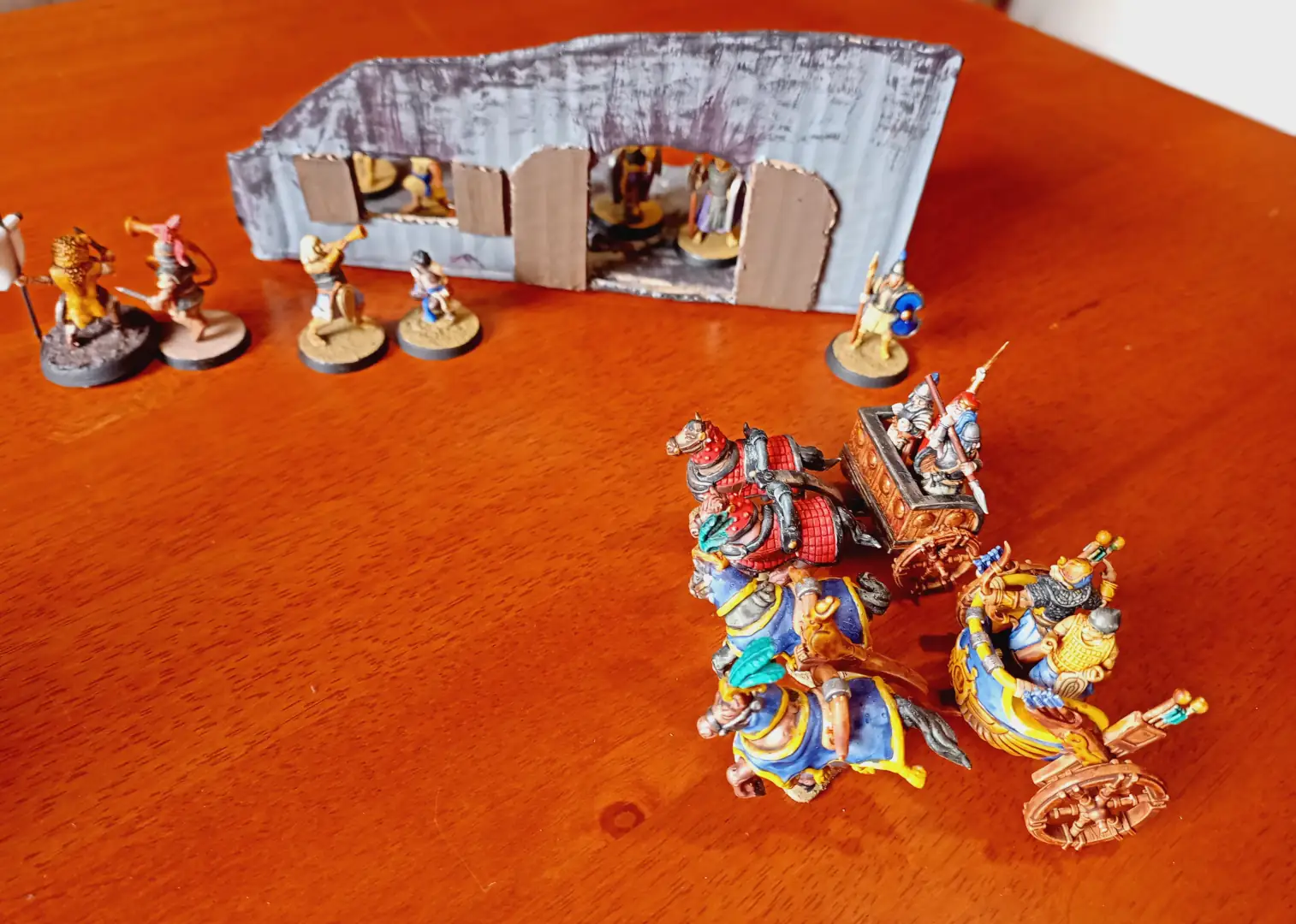
Muwatalli is in the red chariot, and Ramesses is in blue and gold. Muwatalli is furthest from the table edge, so he moves first.
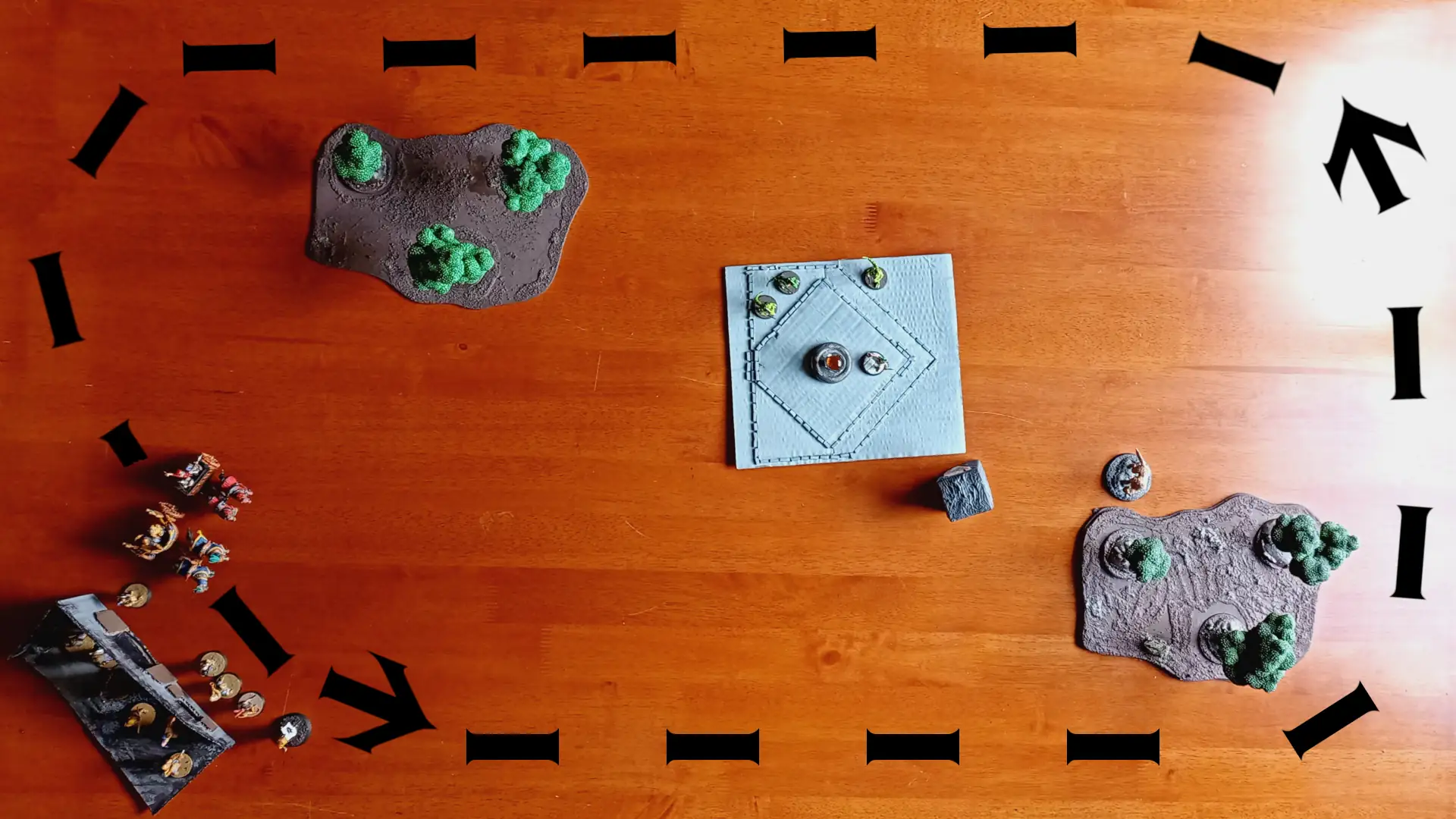
The track starts at an old building, runs past the temple of Ishtar (there are no mechanics for that, the temple is just for flavour), around a small oasis of trees, along the northern plain, round another oasis of trees, and then terminates back at the clubhouse. Nothing fancy.
I didn't customise either rig. I'm just focusing on game play.
Round 1
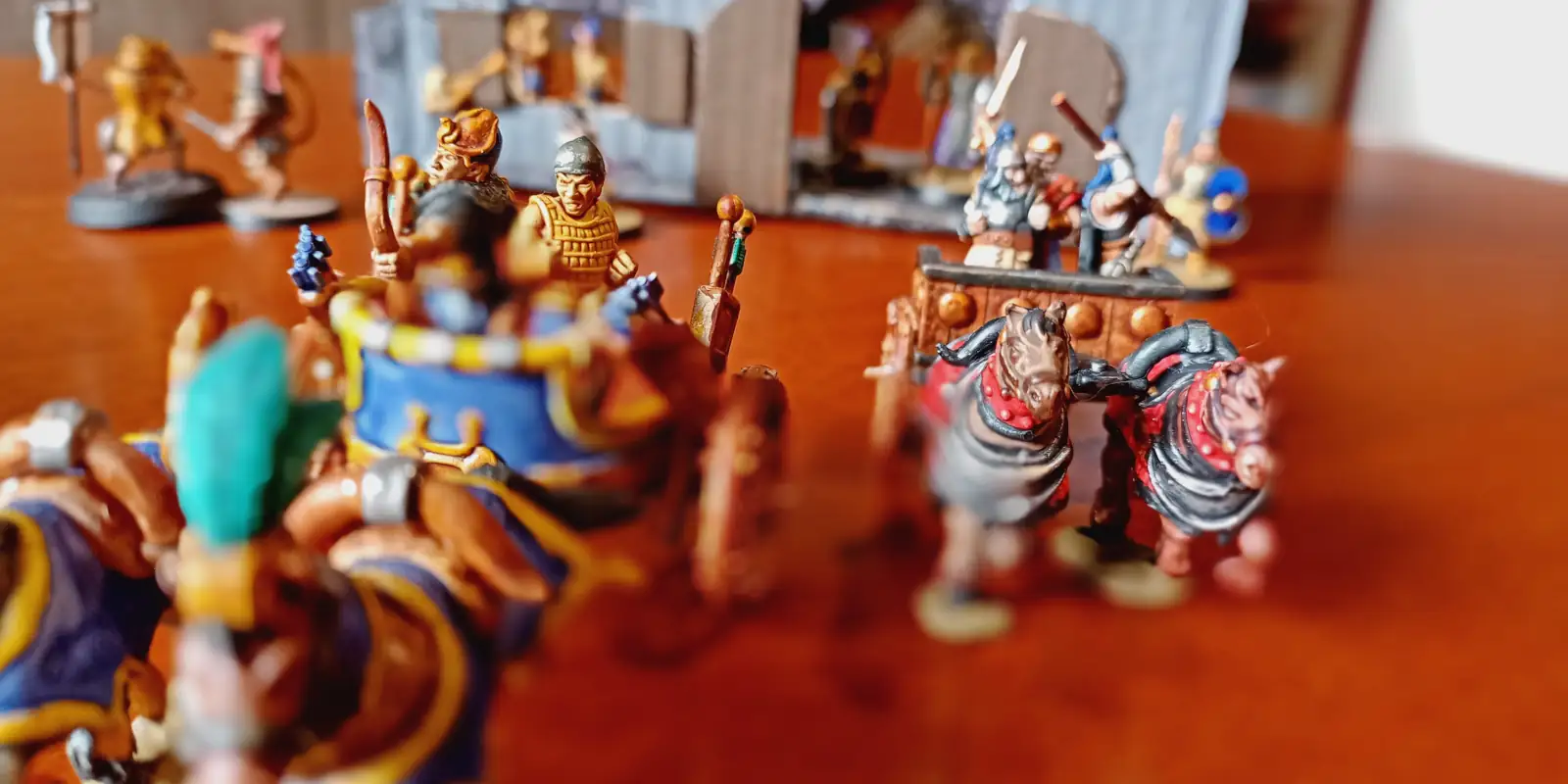
Muwatalli sets his speed at normal (12") so he can pivot away from the building. Ramesses sets his speed at fast (16") and pivots just a little to stay on track.
Round 2
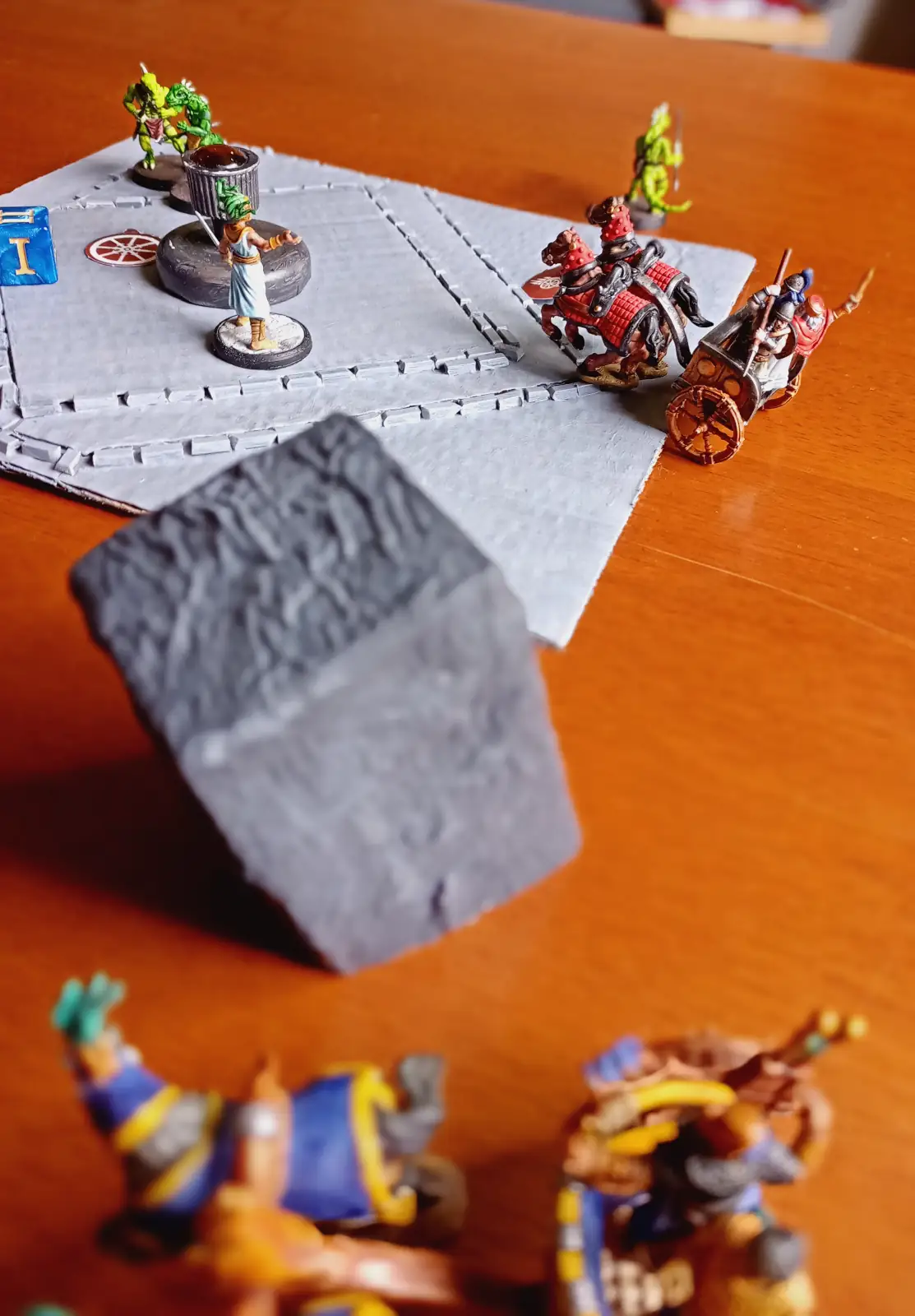
I forget the correct order of things, and let Muwatalli go first. There's nothing but a clear stretch of land in front of him now, so he goes as fast as he can. Ramesses attempts to do the same, and knocks Muwatalli onto the difficult terrain of the oasis. Branches fly into Muwatalli's driver's face, and the first damage of the game is dealt, which limits how fast Muwatalli can go on the next round.
Round 3
Ramesses goes first because he's in the lead, but he takes things pretty slowly because there's a major turn up ahead. He accomplishes the turn with no trouble.
Muwatalli recovers with ease, and the fact that he's forced to slow down probably helps him with the turn ahead. By the end of the round, both chariots are at the start of the northern stretch of track with inches and inches of clear land to cover.
Round 4 and 5
They both ramp up their speed as much as their horses allow, dashing across the northern track. Muwatalli pulls ahead, with Ramesses trailing behind to allow for steering adjustments. But at the end of the fifth round, Ramesses is able to clip the wheel of Muwatalli. He wins the roll off, so Muwatalli rolls on the damage table and gets a 1. Devastatingly, his wheel is damaged and he cannot go above Slow for the rest of the game.
Round 6 7 8
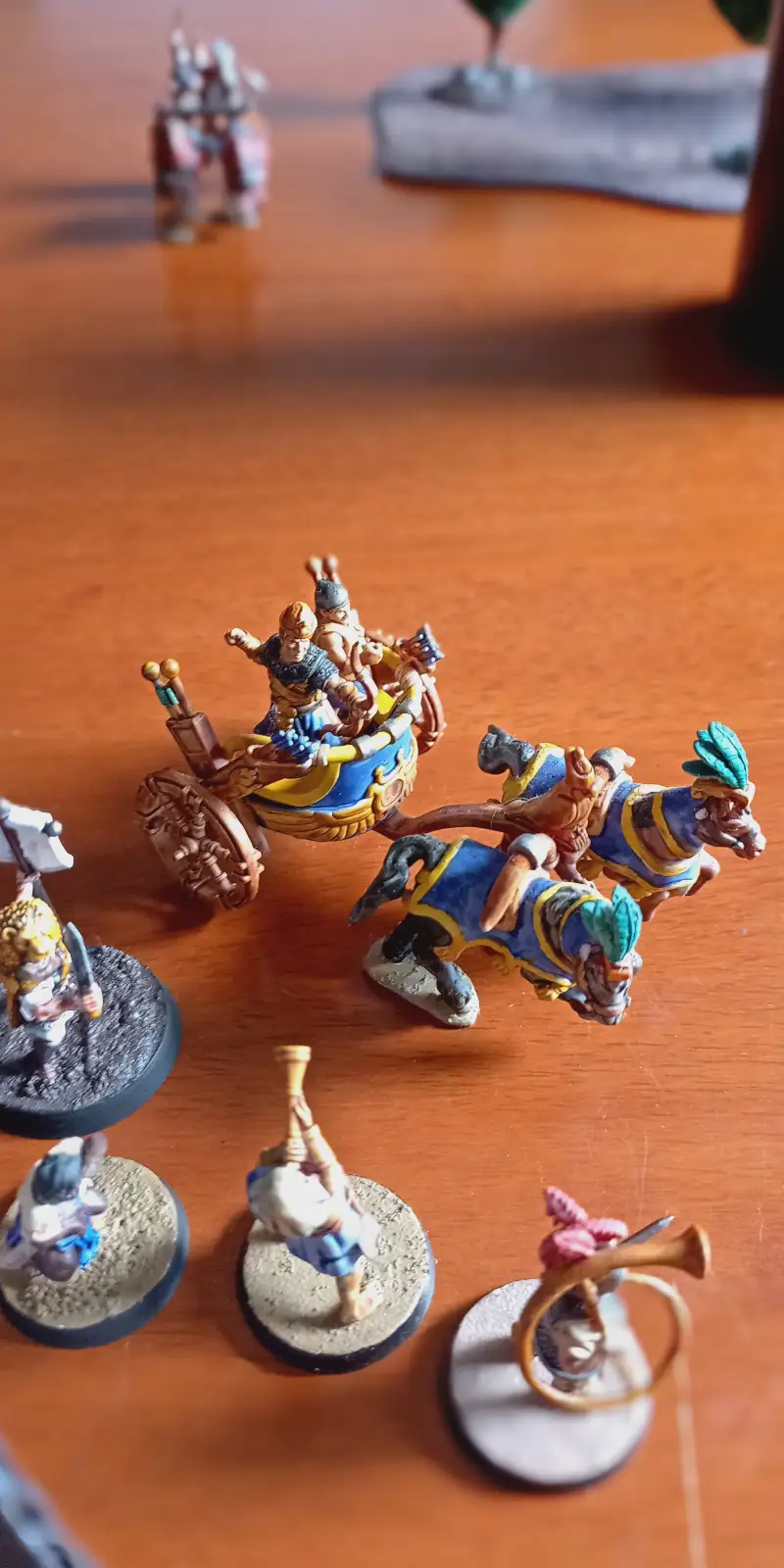
Muwatalli is basically out of the game. His chariot limps along the track, which affords Ramesses the luxury of going relatively slowly to account for turns, and of course to claim victory.
Fun racing game
I loved the combination of methodical measuring and pivoting plus frantically trying to strategise for speed and ramming and careening. I love the simplicity of the rules: Set speed and move, if you hit somebody, roll on a table for a fun effect. What a fun and simple way to emulate a chariot race on the tabletop
My only complaint is that there's a severe lack of clarity on what the dice on the warscroll actually mean, and what damage does, and where damage starts, how many Wounds each chariot can withstand, what the tokens are for, and so on. I'll keep playing the game, and eventually rules will emerge either from game play or from an email from the White Dwarf team. I can't help but notice that this is the first issue of White Dwarf without a managing editor, which makes me seriously wonder about the wisdom of that decision. I'm not saying White Dwarf never made mistakes in the past, but I absolutely feel that these rules desperately needed an editor's attention.
Otherwise, Wasteland Death Race is a fun game. You don't really need chariots to play it, obviously. I can see this being done with trucks in 40k, or mechs, or dinosaurs, or whatever whacky vehicle or monster you have sitting around on a shelf. The rules are good (except the ones that aren't there), and the whole game takes maybe half an hour to play. I'll definitely be playing it again, and this is one of those games that makes you feel like my White Dwarf subscription has paid for itself. This is a clever game I can play with models that don't get put on the table often enough, or with my partner who's not interested in wargames but doesn't mind a quick race around a table, and I wouldn't be surprised if I could use it for dinosaur races with my RPG group curretly playing in Chult. A bargain at any price, but especially as an incidental game in the pages of a magazine. Issue 518, check it out!