I played Far Cry 3 back on my Playstation 3 in 2012 or so, but for one reason or another (for example, moving to New Zealand) I never got around to playing it all the way through. I recently picked it back up on my Steam Deck and, after 100 hours of thoroughly satisfying play time, I beat the game. This is my review of it, with lots of major spoilers. If you haven't played Far Cry 3 and want to be surprised by its plot, do NOT read this review. My short review is that it's by no means a perfect game, but it's a fun game if you enjoy running around a tropical island killing evil pirates with a variety of weaponry.
OK, from here on out there are spoilers.
Far Cry 3 was possibly my first experience with a game where you could roam the game world and capture territory. I was a little disappointed that capturing bases from the enemies didn't actually help me in later battles, but the process of sneaking into a base, disabling alarms, and then executing all the baddies was pretty addictive. The game would have been a lot shorter if I'd just played the main story, but most of the 100 hours of play time was spent capturing bases, finding artifacts, collecting letters, and completing side quests.
I appreciate a game that has an appealing game loop and lets you spend time with it. I suspect the loop I actually like is: Securing an area, plundering the area for treasure with minimal resistance, moving to the next area. I enjoyed that explore-kill-loot loop in Shadow of Mordor, and seeing it written down I'm just now realising that it's very obviously just a dungeon crawl. The benefit to securing an area is that you get the initial challenge of defeating a bunch of baddies, and then you're rewarded by fewer wandering monsters (pirates, in the case of Far Cry 3) as you loot the wider region.
South Pacific Maya
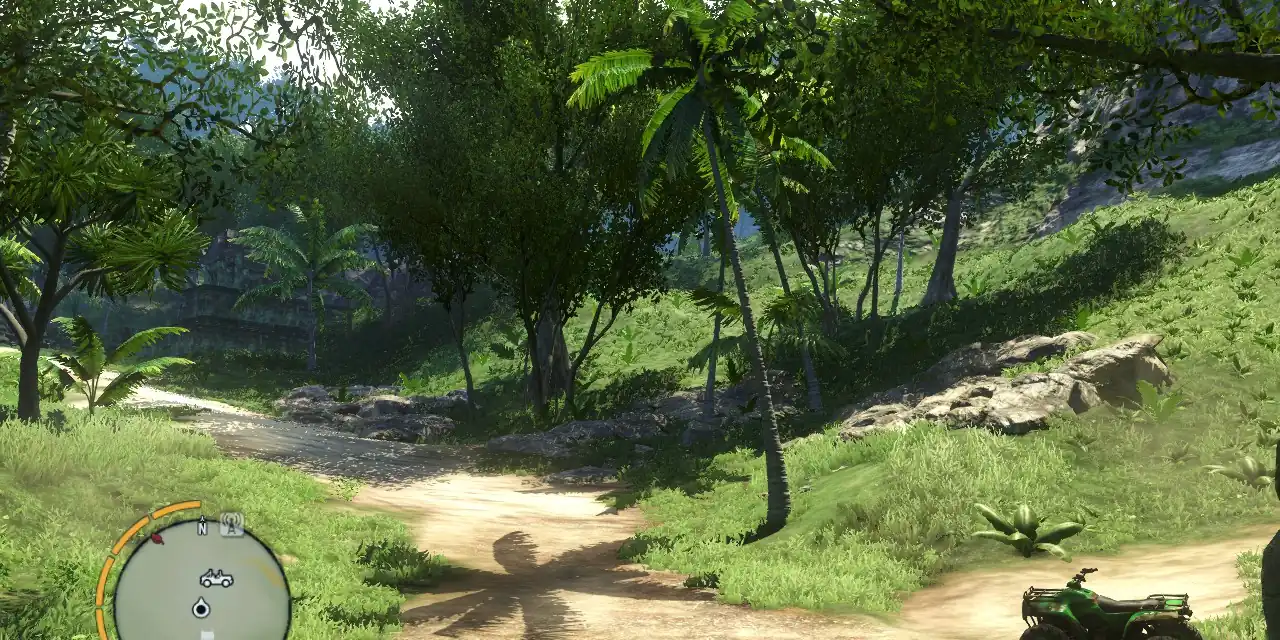
The setting of Far Cry 3 is the Rook Islands, a fictitious amalgamation of Fiji, the Philippines, New Zealand, and Mexico. It's a beautiful setting, and you get to walk, run, drive, and hang-glide around the islands pretty freely throughout the game (one island is cordoned off by a plot force field for a little while.)
The island is definitely a composite of several different real-world locations. Most inhabitants have an obvious Kiwi accent, and more than that actually use kia ora as a greeting. However, the architecture of ancient ruins are pretty obviously South American.
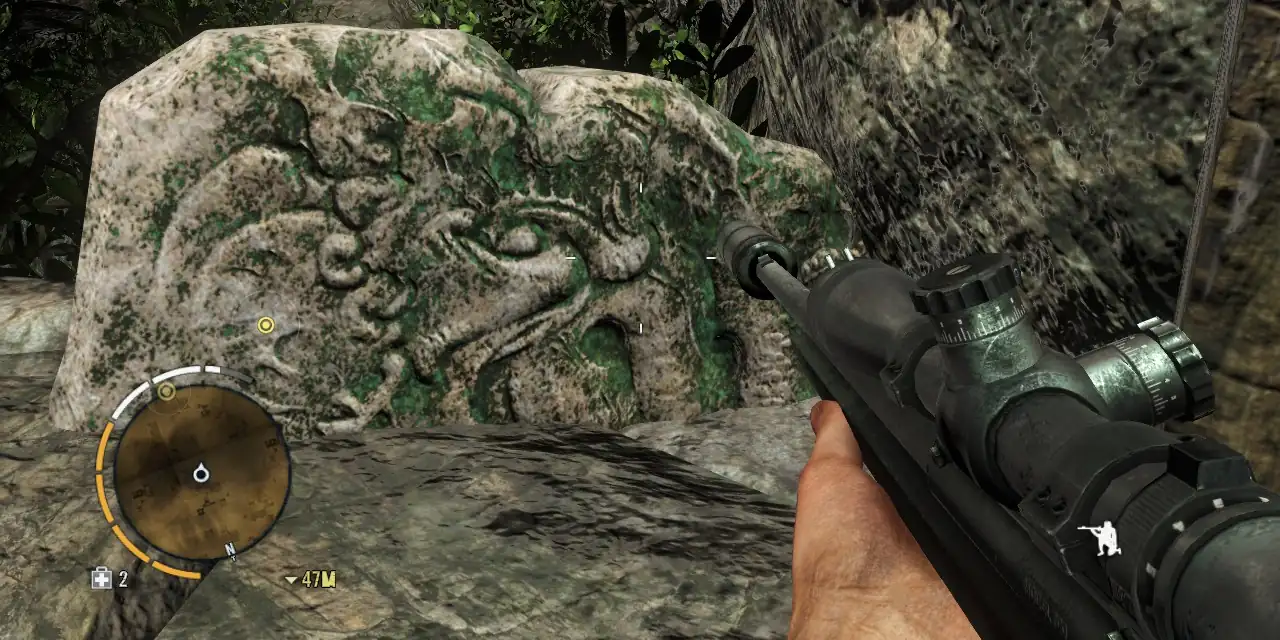
Hilariously, the animal life on the island features tigers, leopards, cheetahs, buffalo, dingos, surprisingly deadly cassowary, kimono dragons, boars, sheeps, snakes, turtles, and bears. When you're not being attacked by pirates and privateers, you have plenty of random wild animals attacking you, so the setting is designed to keep you on your toes.
Economy and looting
The wild animals, you can kill and use their skins to craft gear. Hilariously, the animation clearly shows Jason butchering the animals and leaving the skins, so I wonder if the mechanic used to be that you were killing for food rather than for leather. With the leather, you can craft holsters and belts and pouches. The fiercer the animal, the more your belts and pouches can hold. I never did unlock the third and fourth syringe slots, but I think some benefits are locked behind some challenges that didn't interest me.
The in-game economy is pretty strange.
There is money, and you do have to spend it on ammo.
But you gain access to weapons as you play, no purchase required.
Every enemy has a couple of dollars, there are bounty boards you can do, loot boxes contain money, and you can sell animal skins and foraged plants.
You actually do run out of stuff to spend your cash on eventually.
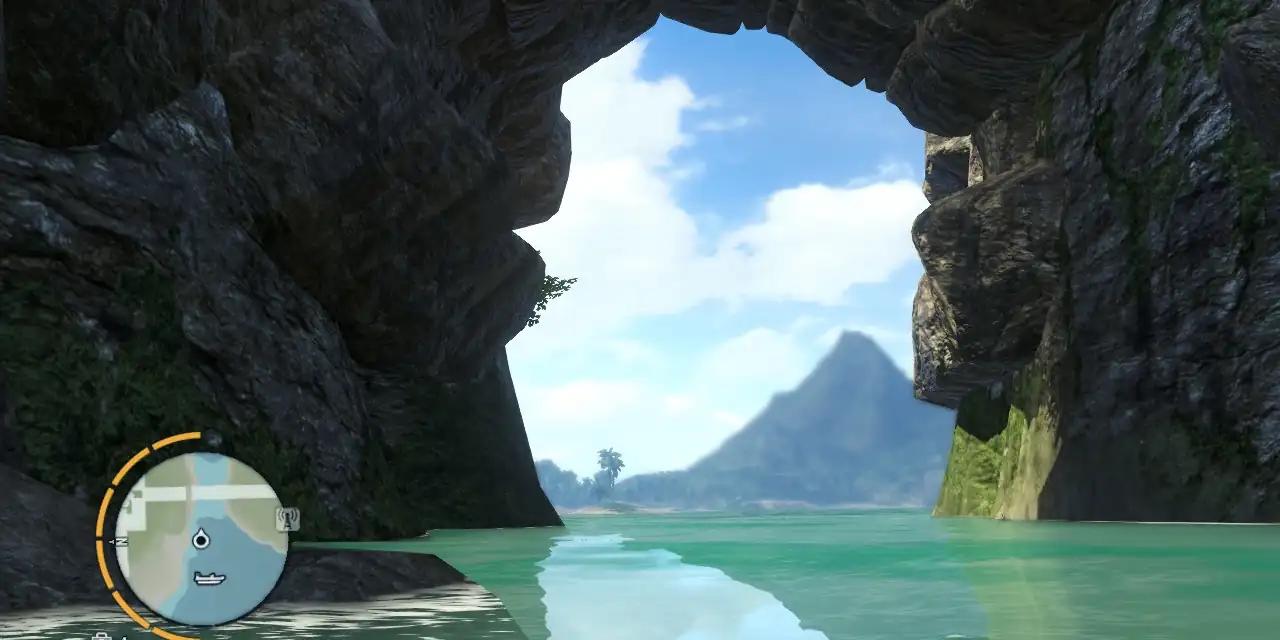
Collecting stuff became a lot less exciting after a while, but those relics kept me pretty motivated. Relics are scattered around the island, some in plain sight and some underwater or deep within caves in places nearly impossible to reach. It's a fun subsystem that I engaged with a lot because it feels a little like a lightweight version of Tomb Raider. It doesn't have puzzles or anything, but they come up with some interesting terrain design that keeps some relics out of sight and out of reach until you find that one ledge or crevice that reveals just the stepping stone you need. There's a lot of messing around with perception and angles, and it works pretty well. Not so well in caves as in outdoor settings, unfortunately. The caves, at least for me, are totally disorienting because the textures are basically the same no matter where you look. You can't tell whether you're looking down, up, or straight ahead. I got tired of spelunking and rarely persisted if the relic I was hunting wasn't immediately apparent.
Story
The mechanics of the game follows the story pretty closely, meaning that this isn't an action RPG or even an RPG-like, even though it does have 3 separate skill trees. As you play, you do have choices between skills, but eventually you're going to collect literally all the skills, so the choice is superficial. They may as well just unlock with the plot, frankly.
The story starts with Jason Brody, his two brothers, his girlfriend, and three friends are kidnapped by pirates. They're annoying college kids, and not very likable (or maybe they're meant to, but I'm not the target audience.) With the help of his older brother, Jason escapes from the pirates and runs off into the jungle. That's the tutorial, so once you've done that you're mostly free to wander.
You eventually find a group of indigenous rebels who, fortunately, have been sitting around waiting for someone who's never held a weapon before to show up and save the island from the violent pirates. It seems that Jason is exactly the guy they've been looking for.
For the rest of the game, you level-up Jason's skills, while occasionally rescuing a friend from pirates. After you manage to kill the main bad guy, Vaas Montenegro (the pretty dude on the cover of the video game box), you discover there's an even bigger bad guy named Hoyt you're going to have to kill. And also, Hoyt is rich and employs privateers with body armour and rocket launchers and flame throwers.
The final third of the game takes place on Hoyt's island, as you plot with a mole in his para-military to take Hoyt down. This ramps up pretty quickly if you play the main quest, but you can take it at your own pace. The game lets you trigger main story quests at your leisure, which I frequently took advantage of because I'm not very good at video games and also I was having a lot of fun reactivating radio towers and taking down enemy bases.
In the end, you kill Hoyt and then discover that the rebels are more like a cult than a liberation front, and they want you to kill your friends to prove your allegiance. You make your choice, and the game ends.

Misplaced and displaced saviours
Far Cry 3 dabbles in some pretty big issues, and I'm not sure it's equipped to deal with everything it tries to address. I have to assume that in 2012 the authors must have been aware that they were implicitly telling a White Saviour story. I really thought this was some kind of commentary, and that it would get addressed at some point, but it never is. You get a few flashbacks of Jason Brody (the character you play) before he and his friends are kidnapped by pirates, and all you learn is that Jason and his friendly are naïve and pretty insufferable. There's even some hints of tension when Jason's girlfriend (soon to be ex-girlfriend) complains that he has, essentially, gone native. But there's no pay-off to any of it. I think the story is attempting to play it straight, as if there's no history in fiction that suggests native populations must be saved by a white man.
An easy fix would have been to make Jason a displaced Rakyat (the native people of the Rook Islands.) Maybe he's holidaying there because he has family history on the islands. Then suddenly he gets involved with the Rakyat rebels and starts down the path of the warrior. No more white saviour, but the conflict and choice between the Rakyat and his college friends remain.
Anyway, that's not what they did, and so the game's story is inescapably a story about a white saviour literally descending from the sky to guide all the natives to independence. It's a strange choice, and wasn't aging well even while it was being made, much less 12 years later.
There are other topics, too. One of Jason's friends is clearly traumatized after being kidnapped, tortured and, I think the suggestion is, sexually abused. This is definitely not a video game capable of handling that sensitively, and it seems out of place when it's addressed (and then quickly resolved.)
Choices in a first-person shooter
Far Cry 3 isn't a perfect game, and video games aren't exactly known for player agency (that's why we play tabletop games) but sometimes the actions and choices you're presented with just don't make sense. Jason is egregiously stupid. It makes sense for him to start out naïve, because he's meant to grow and develop and change through the course of the story. But eventually you find yourself shouting at your screen for Jason to stop trusting everyone, and he never does. He walks into traps, and he makes alliances with people who are clearly going to betray him.
Choices presented to you as the player that only happen because of some poor choices Jason has made in a cut scene are difficult to accept graciously. This is especially true in the big final choice of the game. Jason misses all the warning signs, even if you as the player don't, but in the end you're still stuck with a very binary choice: Cut the throat of your ex-girlfriend or lose everything you've gained on the island. As a video game, Far Cry 3 doesn't have the tools to pose the dilemma of whether you want to stay on the island or go back home, neither technically or narratively.
Far Cry 3 establishes the ex-girlfriend as surprisingly judgmental of Jason as he does whatever is necessary to rescue their kidnapped friends, and does no real work in creating an emotional connection to Jason's former life. The final choice appears to be between returning to an annoying frat-boy lifestyle with a girlfriend who'd rather you leave your younger brother to die, or to stay on a tropical island as an accomplished and honoured warrior with a beautiful priestess. Even if that is the most appropriate choice for the game, it's a video game that must be pre-scripted, so there's no negotiation possible. You can accept or decline, you can't reason it out, or trick the priestess into letting your friends go, or make threats, or try to convert Citra's followers into your own champions, or whatever you might come up with as a player in a tabletop game.
Knowing it's just a video game is a strong influence to behaviour, too. I had no reason not to cut the throat of an imaginary character who's only said judgmental things to me throughout the entire game. Give me a choice between someone clearly unlikable and someone who's been helpful, and I'll take the nice person, which in this case triggers the bad ending.
In the "bad" ending, Citra makes love to you and then kills you, for some reason, convinced that she is now pregnant with your child.
In the "good" ending, Citra says your friends are going to go and have children and lead boring lives (which seems hypocritical given that in the bad ending her goal seems to be to have Jason's child), and then saves your life by throwing herself in front of the knife meant for you. Her dying words are "I love you, don't leave me" but Jason doesn't even bother comforting her as she dies.
All in all, some pretty rubbish choices with not great outcomes. But after the ending, you can stay on the island (even if you died) and explore more and do more challenges. I started to, because I did kind of want to 100% all the relics and story challenges, but after getting sucked into yet another scenario where you're on rails and have to keep retrying until you match the pattern correctly, I decided I was done with the game for now. It's fun, but on-rails scenarios are tedious in the best of games.
A game with fun mechanics
Far Cry 3 has a lot to offer, and it tries to encourage you to engage in everything by locking a few token abilities or skills behind different kinds of challenges. I had to do two timed car races to unlock a special takedown move, and I only wanted that skill because I was aiming for the 100% skill tree achievement. I didn't end up getting that achievement, with just one skill remaining, because there was a challenge that, especially late in the game, was difficult to even set up (I needed to find an enemy to take down while on a ledge, but I'd cleared all enemy bases by then.) It's an odd choice, and I think the game would be better if it trusted in its own mechanics more. With so much to do, there's something for any player that's picked up the game in the first place. There's no reason to lock anything behind specific activities, because once a player has found a few activities they enjoy, they're likely to spend 100 hours happily doing just those activities.
Ultimately, Far Cry 3 is a fun game with a beautiful setting and lots of strong mechanics. I enjoy having the freedom to choose when the main story scenarios begin, I enjoyed the process of liberating enemy bases, I enjoyed the variety of weapons to choose from. I didn't enjoy the story or the characters, but I guess this proves that good game mechanics can sometimes overcome an underwhelming story. (Also, Ubisoft's requirement to sign in to Ubisoft just to play the game is stupid, and almost convinced me to stop playing the several times it broke down.) It could do without the on-rails scenarios, but it made interesting use of quick-time events, especially for its boss battles. I don't think Far Cry 3 is a must-play game, but I think it's a mostly well-designed one.