I was introduced to Flesh and Blood (FaB) a few years ago when a card merchant included a freebie FaB card in my order of RPG books. The card seemed interesting to me, so I bought a small starter set with 2 pre-constructed decks. I didn't know how to play and I had no one to play with anyway, so it sat on the shelf for a few years until I met a FaB player, and he and I have been playing a weekly game on Friday afternoons for the past year now. The immediate question I'm asked by any gamer who sees my Flesh and Blood t-shirt is "Can I replace Magic the Gathering with Flesh and Blood?" The answer is an emphatic yes, but with the caveat that Flesh and Blood is not exactly the same as Magic the Gathering (MTG).
Flesh and Blood has superiour game design
Flesh and Blood is objectively superiour in game design to Magic the Gathering. That seems like a bold claim, but I don't think it actually is. Like all of us, FaB had Magic the Gathering, the literal originator of the format, to learn from. The influence of Magic the Gathering can't be overstated, not just to trading cards, but to gaming in general, and even to fantasy media itself. Games that come after Magic the Gathering ought to be superiour, because none of them are weighed down by minor mistakes that Richard Garfield never imagined would matter because he never imagined his game would be the start of a new kind of game and a whole new industry.
Here's why I say Flesh and Blood is an objectively better game:
- Resources not mana: You always have enough resources to play a full turn. The same cards you attack your opponent with are the same cards you use to defend and to power your attacks. The way you use your cards is up to you, so if you're ever short on "mana" (it's just called Resource in FaB) then it's your own fault.
- Classes not colours: I love the 5 colours of magic in MTG but there are only 5 of them. FaB uses character classes, like in an RPG, to define how a deck plays. A Brute hits infrequently but really really hard. A Warrior strikes frequently for low damage, and defends effectively. A Mechanologist builds engines to deliver damage. An Assassin marks an opponent for bonus damage and debilitating effects. And so on. FaB provides methods of playing that are surprisingly diverse.
- Battle chain not battlefield: It works because it's been around long enough to become normal, but MTG's battlefield, with summoning sickness, combat phases, The Stack, is charmingly confusing mess. The chain in FaB is orderly and visually clear. You know exactly what's attacking, what's available for defence, what permanent effects are in play, what effect happens first, and so on.
- Go again, not game phases: FaB solves the confusion of game phases and board maintenance by keeping things simple. On your turn, you get to do an action. If the action says Go again, then you get to do another action. If not, your turn is over. Simple, but infinitely flexible.
Resource management
In Flesh and Blood, every card, such as Savage Swing has a resource value (depicted with 3 red dots in the top left corner.) Likewise, every card has a resource cost (depicted by a number in the top right corner.)
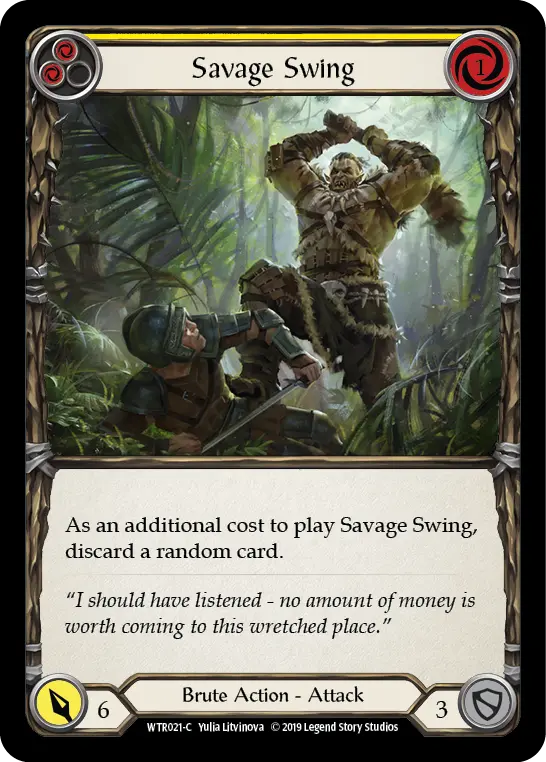
To play Savage Swing, you must pay a cost of 1 resource. As it happens, this particular card also has a special rule, printed in the bottom half, that requires you to discard a random card. That's a special rule, just for this card, because the card is pretty powerful.
Alternately, you might choose to "pitch" Savage Swing, meaning that you don't play it but place it at the bottom of your deck in exchange for its resource value. Savage Swing is worth 2 resource points.
That's the accounting system. You can pitch cards to cash them in for resource value, or you can attack with a card by paying its resource cost.
There's no mana and no land. Every card has value, every card has a cost.
Combat
In the bottom left of attack cards, there's an attack value. On Savage Swing, it's 6.
In the bottom right of most cards, there's a defence value. On Savage Swing, it's 3.
After paying its resource cost (1 and a discarded random card), you can attack with Savage Swing and deal 6 damage.
Suppose you were playing Brute against Brute, and your opponent also had Savage Swing in their deck. Were your opponent to choose to use Savage Swing to block your attack, you would only do 3 damage because 6 attack - 3 defence = 3. Your opponent might use more than just Savage Swing to block. Maybe your opponent uses Argh Smash! to block, which is defence 3. That would reduce your damage to 0. But it's also cost your opponent 2 cards, so they only have 2 cards to use during their next turn against you!
Combat and summoning
These are card games I'm talking about, and the fact that I can honestly say that they feel different to play says a lot about each game. Both Flesh and Blood and Magic the Gathering are highly evocative games, and they both have a depth to their rulesets that inspires hours of sitting around and reading cards and obsessing over cool combos and synergies. Both games have, very broadly, the same game loop: You produce cards from your hand to reduce your opponent's score, and they produce cards from their hand to block your attempt.
And yet they do feel different.
In Magic the Gathering , you feel like a wizard (well, Planeswalker) casting spells, not only because that's explicitly what the game tells you to feel like, but because that's the mechanism you're provided. You have a hand full of summoning and aura and instant spells, and you place them on the table in front of you, and at first they often can't do anything (unless it has Haste or is an instant, and so on), but there they stay as your minions that can go out and destroy things for you.
Flesh and Blood makes you feel like a fighter. You have weapons, armour, and actions. Every action is an attack (not actually, but mostly), and your opponent desperately parries while also trying to ready their next attack. If you can catch them off balance this turn, then you're confident that their next attack will be weakened. You feel the impact of every card you use, whether you use it to attack, defend, or pitch. And I've never played a game that wasn't neck and neck.
Similar games, but from a roleplay perspective, they're completely different, and that actually surprises me. If you look at them from afar, you'd probably think they were the same game. But once you're in the game, they're wholly unique.
Why I'm buying Flesh and Blood
Flesh and Blood isn't a Magic the Gathering clone, so it's not something that can take the place of Magic the Gathering as a game. But, it just so happens that Flesh and Blood can take the place of a lot of the activities that you might have expended on Magic the Gathering. I've moved away from purchasing Magic the Gathering cards, and I'm now just buying Flesh and Blood decks and singles. There are a few reasons why.
Play group pragmatism
The people I played Magic the Gathering with are in Wellington, on the North Island, and I've moved to the South Island. At best, I get to play Magic the Gathering once a year during KapCon.
Flesh and Blood has a healthy scene in Dunedin, and there are a few people, 2 minutes away from me, who play it in the town where I live.
At some point in my life, I'd have probably tried to start a Magic the Gathering play group here. But I'm happy playing Flesh and Blood, and I'm not terribly happy with Magic the Gathering.
Worldbuilding
The Magic the Gathering team claims to be doing just as much worldbuilding as ever, but that's obviously not accurate. The "Universes Beyond" releases have displaced regular releases. Are we ever returning to Ixalan? Probably not. Will we ever see another Amonkhet release? I doubt it. Maybe we wouldn't have anyway, but I feel like now that they're competing with Teenage Mutant Ninja Turtles, I don't see how they have a chance.
I guess you can't argue with economics. If TMNT sells more decks than Ixalan, then the market has obviously made its judgement. But the problem is that the market used to be just the Magic the Gathering players. Universes Beyond targets other "fandoms," so obviously they're going to sell more cards.
You can return to the world of a trading card company that's generating its own content with Flesh and Blood. There are regular releases of Flesh and Blood stories on the official website, set in the world of Rathe. And they're really good stories, set in a world that feels alive and dynamic and dangerous and exciting.
Flesh and Blood strikes that great balance that good speculative fiction always has, sometimes inventing new ideas wholesale and other times riffing off what's popular. The setting of Rathe is a comfortable hybrid world where magic, gladiators, kings and queens, pirates, and steampunk (or maybe ætherpunk) are intermingled. And there's a lot more to explore, obviously, and it's hard to anticipate where things could possibly go next. But that's the fun of a trading card game that doesn't make trading cards for stuff that already exists. You're not buying FaB cards because you saw the movie already, or read the comic book, or watched the baseball game. You're buying FaB cards because they're part of the story reveal. They're building the fictional world you're following, and it feels like old MTG.
Artwork
Art is subjective, and there are a lot of Magic the Gathering cards. Like everybody else, I know what I like and I know what I don't like. In 2021, I accidentally purchased a copy of Carly Mazur's Faithless Looting card. Every time I sat back to leisurely gaze at my MTG cards and then came upon Faithless Looting, it just didn't fit in with the rest of my cards. It's not that the art is bad, because art is subjective. Some people really like this art, and probably love that Magic the Gathering finally did something different.
For me, this just isn't what I want in my fantasy trading cards. And for now, Flesh and Blood has established a strong identity in good "traditional" (as arbitrarily defined by me, according to what I grew up with) fantasy art.
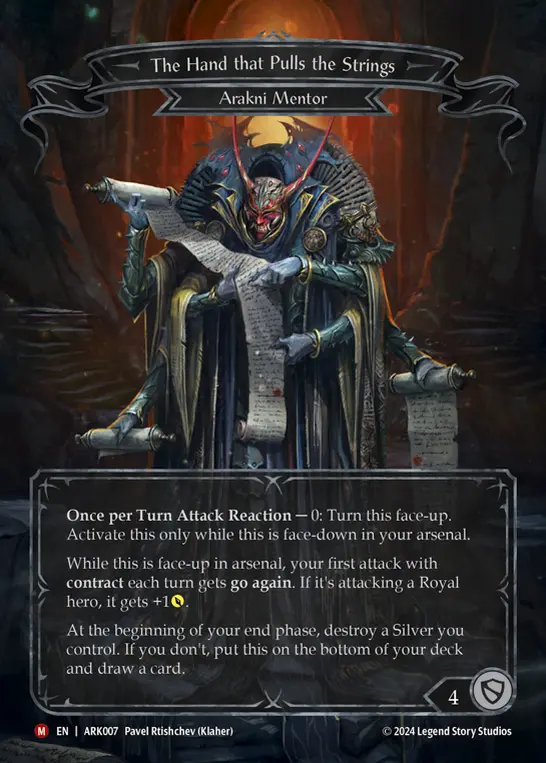
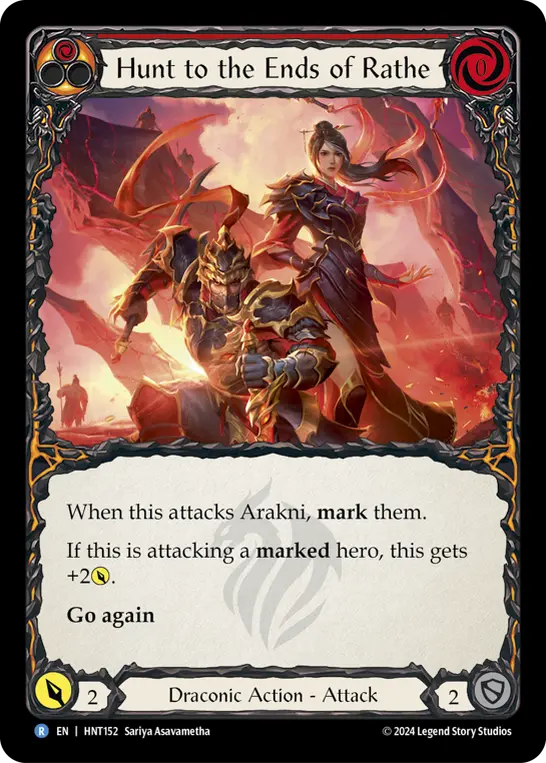
Flipping through my Flesh and Blood decks consistently inspires me. It inspires me to create stories about the images I see, to build cool new decks, and to play more games. That's what I want out of my fantasy trading cards.
Play Flesh and Blood
I'm not angry about the way Magic the Gathering is going, but it's not a path I'm willing to follow myself. It's still a successful card game, and that honestly makes me happy. I'm happy that one of the best games in the world is still being produced, and is still under the care of Mark Rosewater, who I think is a pretty brilliant game designer. I don't want MTG to fail, but that doesn't alter the fact that it has found a different audience.
Conveniently, I have found a different game to enjoy. Flesh and Blood is an exciting and evocative trading card game, with vivid modern fantasy art, clever design and clever set design, and a bunch of innovative delivery systems. The Smash Palace box set is a great way to get started, with 4 decks included, and an Event Deck that imposes surprise extra rules that apply to all players for the round.
It's a game where there's a lot of creativity happening, and I guess probably most importantly it's got engrossing game play. For the hour or 2 or 3 that I play, I focus on nothing but the game, because victory is always down to the wire. It's a real achievement, Flesh and Blood, and you don't have to hack around mana ramps and theoretical stacks or anything like that. You just grab a deck and play, and if you're interested in trading card games and haven't done that yet, you should.
All Magic the Gathering art is copyright by Wizards of the Coast. All Flesh and Blood art is copyright by Legend Story.