I've written about how much I love a good gaming magazine before, and I've just finished the very good issue 522 of one of the few remaining gaming magazines, White Dwarf. I subscribe to the magazine, and it's a good thing I do because this isn't an issue I think I'd have thought to buy off the shelf. The cover's cool, showing a big angry space marine, but those are a dime a dozen, and the table of contents lists a lot of content about the Red Corsairs, which I have no particular interest in. At least, I didn't think I had a particular interest in the Red Corsairs, but because this magazine got delivered to my mailbox, I felt obliged to read it cover to cover, and now I am super interested in Huron Blackheart and his Red Corsairs. Not only that, but I've got a self-made map of an Ossiarch stronghold, taken from a wonderful tour provided in this issue, to explore. I was surprised at how enraptured I was with this issue, and I think I read the whole thing over the course of just two evenings. Here's what I loved about issue 522 of White Dwarf.
Chaos Space Marines without all the chaos
I knew of Huron Blackheart and the Red Corsairs from having read some reports on the Badab War, and it registered in my memory as a highly political story line that sort of had a hard scifi feel to it. Issue 522 condenses a lot of the information we got back in 2010, in the Imperial Armour magazine, about the Badab War. Re-hashing stuff that's already been published can seem trite when done poorly, but in this case the authors struck the exact right balance between summary and contextualisation. The Badab War as an isolated event is super interesting, but it's also really dense. You have to understand a lot about how the Imperium works to understand why the conflicts happened in the first place, and I definitely did not have the in-depth knowledge required when I first read the Imperial Armour reports of the battle.
Issue 522 helps the Badab War make sense. You understand why the Astral Claws (as the Red Corsairs were called before they betrayed the Imperium) got involved, you understand why Huron Blackheart rose to power within his chapter, and why he eventually turned his back on the Imperium. There's a lot of subtext even in the summary, though. You can see how Huron Blackheart's blind allegiance to the Imperium was actually just an excuse to grant himself boundless authority. Huron Blackheart has such a toxic infatuation for the Imperium that he feels betrayed when the Imperium upholds the very rules he claims to value. His patriotism turns into insurgency the moment he can't have what he wants, and of course his entire chapter follows him, because the Imperium thrives on the cult of personality.
At the expense of the Badab system, the Astral Claws become the Red Corsairs, a traitorous space marine chapter that doesn't have the same baggage as Chaos Space Marines. They're definitely a Chaos faction, and the Red Corsairs absolutely use the dark powers of Chaos to their greatest advantage, but they're relative newcomers and they're not devoted to a specific Chaos god. In fact, it seems to me that Huron Blackheart is pretty content with just harrying the Imperium out of spite. There's no Abaddon-level master plans that we're aware of. Instead, the Red Corsairs are a band of grumpy space pirates that can show up at exactly the worst time in your campaign. They can storm in and push people around, or they can activate full Chaos mode and serve as evil space wizards with no agenda other than ruining your army's day.
In a way, the Red Corsairs feel like Chaos's very own Imperial Agents. Huron Blackheart is happy to ally with xenos if it serves his immediate needs, or with Chaos if that's useful. I can easily imagine running a motley crew of Red Corsairs, some Black Legion, the obligatory (and indispensable) traitor guardsmen, and whatever spare xenos I have lying around.
In-game history plus real-world history
There's about 20 pages of Red Corsairs content in issue 522, and every bit of it is interesting and inspiring. As a little added bonus, there's a two-page spread about the real-world history of Huron Blackheart. I was surprised to learn that it all started way back in Rogue Trader! In the real world, he's as old as Horus.
Geek culture is pretty mainstream now, with some geek properties maybe more accepted than others, and it's interesting to see how companies handle their own real-world histories. Games Workshop definitely does a pretty good job of acting as its own historian, and articles like this are nice ways of exposing how the fiction of Warhammer has been developed over the years. If nothing else, it helps us geeks understand how canon is both illusory and also a defensible in-world convention. Sure, Huron Blackheart is mentioned in Rogue Trader, but if you look at the artefact you see that actually it's "The Tyrant of Badab" that's quoted. This nameless tyrant was only later given the name Huron Blackheart and the identity of an Adeptus Astartes later on. In [theoretical] alternate timelines, the Tyrant of Badab was just an under-trained planetary governor, or an over-reaching general of the Astra Militarum, or even a xenos usurper. I love canon, but I also love seeing the support structures holding it up.
Ossiarch necropolis
Over in the pages dedicated to a completely different setting, there's an Age of Sigmar article written as an in-universe report about the exploration of an Ossiarch necropolis. This is another article I only bothered reading because the magazine had been put in my mailbox and I'd have felt like I'd wasted my money otherwise. I don't play Age of Sigmar and, let's face it, the world-building for it is a little bit of a mess. Nobody really understands what a mortal realm is, or where it is, or where they are in relation to one another, and nobody cares about Stormcast Eternals.
By contrast, the monsters of Age of Sigmar are excellent. Every monstrous faction has well-developed lore, intricate and well-defined social structures, pretty clear goals, and they're often strangely sympathetic. The Ossiarch Bonereapers are classic undead, and I mean really classic. I don't think anything's more classic than an animated skeleton. Before I first read about animated skeletons in AD&D, I knew that skeletons could walk around from classic Halloween cartoons. It's innate, we all just know about walking skeletons in the same way we know about ghosts and goblins. Ossiarch Bonereapers are basically that trope, with some decoration to make them look fancy, and a real need for bones. They use bones for almost everything, so they're always looking for more. And luckily, there are bones in nearly all the significant living beings in the Mortal Realms. When a Bonereaper attacks, it's not personal, it's just harvest time.
The tour of the Necropolis in issue 522 is "written" by Marshal Vigar Obolswald, who along with Arch-Knight Lombar, Surgeon Agat, and Soul-priest Isram, bravely entered the fortress of Xa Phyxon to explore it. The report describes the outer walls, the inner hold, the battlements, the cathedrals and forge and throne room, trophy room, library, stables, and a bunch of the cunning threats within. It's an entertaining story on its own, with a high body count, but it's a thrilling and atmospheric journey. If you close your eyes between paragraphs, you can see the bone walls and carvings of the necropolis for yourself.
This evocative piece of writing reads like a classic dungeon crawl, which is exactly how I intend to use it. Inspired by the article, I mapped the fortress out on graph paper. It's just one interpretation of the necropolis, and one heavily biased toward making it a usable map in an RPG or wargame.
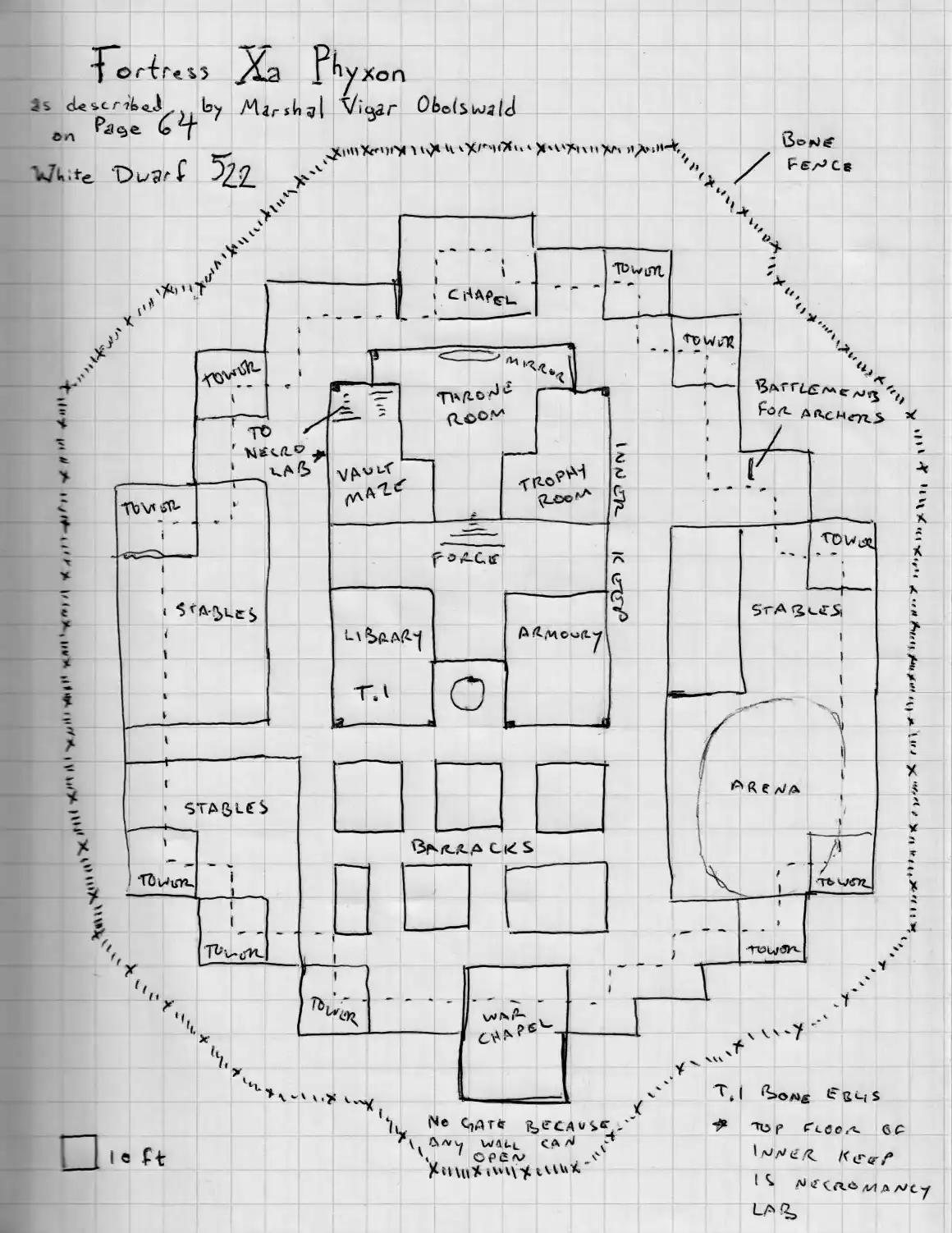
The article only mentions one specific monster (a sort of bone ibis, I think) that kills Arch-Knight Lombar, and one trap that kills the surgeon Agat. Luckily, the "bestiary" (such as it is) of Age of Sigmar provides plenty of bone-based creatures for me to populate the necropolis with during a game. I also happen to own a modest assortment of skeletal DnD miniatures, so I think I've got enough options for running a bone-themed necropolis as a dungeon. What game system I'll use for it, I don't know yet. I guess it depends on what gaming group needs it first.
Fun issue of White Dwarf
Issue 522 was a fun issues of White Dwarf to read. There's some game content for Warhammer Quest: Darkwater, but I don't own that yet so I'm filing that away for later. For now, the lore sections of the magazine had really well written content that inspired me to obsess over patchwork armies and bone-themed dungeon crawls. And I haven't even mentioned the on-the-edge-your-seat Boarding Actions battle report that genuinely had me eager to turn the page for more, and also literally laughing out loud at some of the relatable frustration at dice rolls gone wrong. There's a hilarious interaction in the battle report between Huron Blackheart and his xenos enemy, in which two great heroes face one another at last, only to have every plan foiled by dice-based surprises. It was a pleasure to witness.
Issues like 522 make me feel connected to my hobby in a unique way. It's obviously devoid of social interaction, which is strangely comforting at times. The private enjoyment of gaming is a very familiar and comforting feeling for me, because for most of my life I was a solo gamer, and in many ways I still am, at least deep down. I have two gaming groups currently, and a fortnightly card game, and I run games at conventions, and I'm a member of a local[-ish] game club, so I'm obviously a social gamer now. But the time I spend alone with a game system is the time I bond with that game rather than with the game and the people playing it. For whatever reason, I value my own personal perspective on a game, and I don't think I'd enjoy the hobby as much if I didn't make time for solo play and reading. Issue 522 of White Dwarf was time well spent with my hobby.