Flesh and Blood is a trading card game in which you play a hero battling to the death against a powerful enemy. It's mostly a melee game, in the sense that its fighting style tends to feel direct. You don't summon creatures to do your fighting for you, and instead do your own dirty work. You're not controlling a battlefield, but dueling with a specific and singular hero, wearing down their armour and ability to deflect until finally you reach victory. Best of all, Flesh and Blood provides a clean, rational, and consistent rule set that manages to stay flexible enough for every hero to feel unique. Basically, this is an amazingly good card battle game, and I play it weekly with a fellow Flesh and Blood (FaB) fan who lives just up the street from me. I think anyone interested in trading card games ought to give it a try. Here's what you need to know to get started.
Read the lore, marvel at the art
You don't need to know the lore of the world Rathe, the weird fantasy setting of Flesh and Blood, to play the game but if you fall in love with a game through its lore the way I do, then you'll be happy to know that Flesh and Blood maintains and nurtures its story. You can read all the short stories released for the game on its official website.
The official website also provides an overview of Rathe's important regions. Unsurprisingly, there's a region of Rathe prone to high magic and mystical wonder, another region that's fallen into gothic horror, there's adventure on the high seas, a steampunk region, and so on. Rathe is a catch-all setting, a lot like Golarion in Pathfinder. It's a big ol' planet, with plenty of room for all the tropes you want out of your fantasy setting. Would I play an RPG set in Rathe? In a heartbeat.
The art of Flesh and Blood is the kind of fantasy art you remember as a kid. I can sit for hours just thumbing through card decks, getting lost in the art. It's like a non-linear comic book. I'd absolutely get prints and hang them on my wall, were I the sort of person to put things on walls.
Buy a Blitz deck
It's a physical card game, so Flesh and Blood of course has lots of different formats you can play. You can ignore most of them, and start with either Armory deck or a Blitz deck.
- Armory deck: 60 cards and a hero with 40 life points
- Blitz deck: 40 cards and a hero with 20 life points
I recommend starting with Blitz because it's a fast and exciting format with games that last maybe an hour. It's a great way to learn the game, because you don't get muddled with complex strategies, and when something does go horribly wrong for you it's not a big deal because you die quickly and can just start a new game.
The rules of play (if not deck construction) are the same for Blitz and the classic game, so everything you learn in Blitz translates over to classic.
You can build a deck yourself instead of buying a pre-constructed deck, but I recommend starting with something off the shelf before you try to build your own.
Setup
The opening ritual of a Flesh and Blood game is setting up your play area (called an "arena" in FaB terminology.) I love this, because when I sit down after I haven't played for a couple of weeks (like over the New Year holidays), I usually convince myself I've forgotten everything. Then I start setting up, and it's such a familiar and comforting routine that I realise that I do remember how to play. These cards go there, this card goes here, shuffle this deck, and play.
Here are the cards you need to setup.
Hero card
In each deck, there's a hero card. You can identify a hero card by the card type, listed at the very bottom of the card. A hero card always includes a class (Warrior, Ninja, Assassin, Brute, Pirate Necromancer, and so on) and the word "Hero."
A hero card displays your hand size in the bottom left corner and your life point total in the bottom right corner. For example, the Blitz version of Dorinthea has a hand size of 4 and a life total of 20.
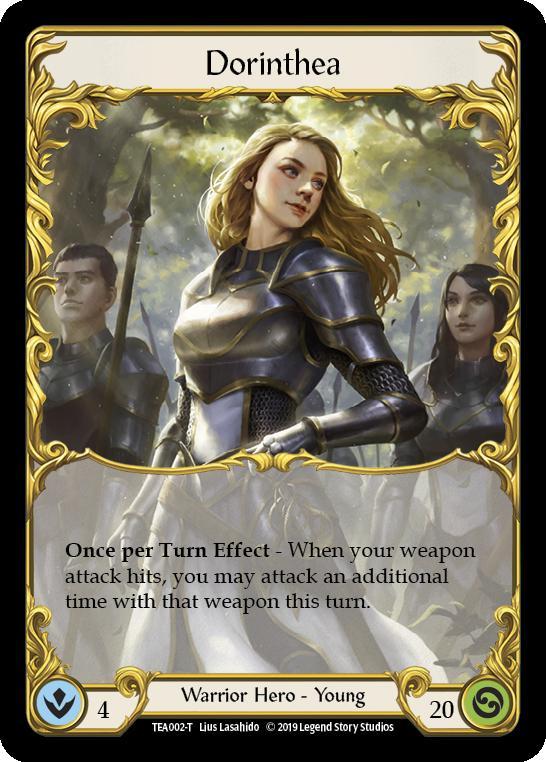
Most heroes have a special ability, written on the card. In Dorinthea's case, once per turn when your weapon attack hits, you may attack an additional time with that weapon this turn. As you might surmise, Dorinthea is designed to attack frequently, which is different to, say, Rhinar, a brute who hits hard but probably only once each turn.
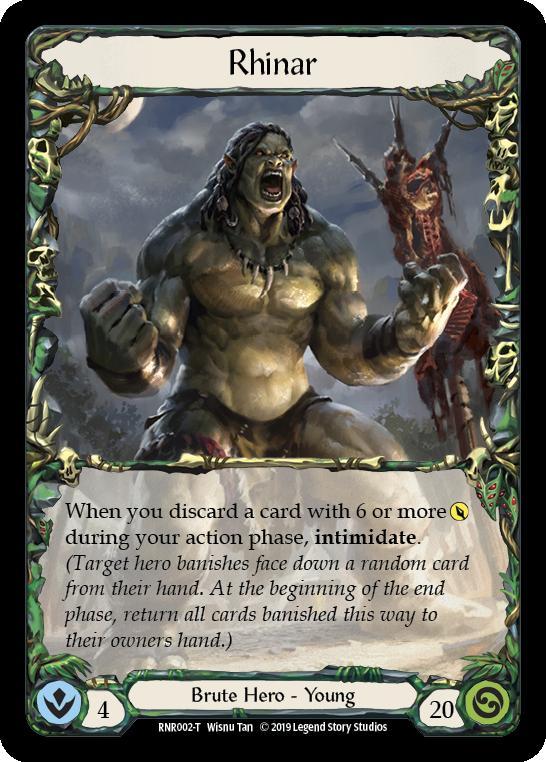
Place your hero card face up in the centre of your Arena.
Weapon cards
Most heroes also wield weapons. You can identify a weapon card by its card type, listed at the very bottom of the card. A weapon card sometimes includes a character class, or else the word "Generic", and always includes the word "Weapon."
Some heroes have two weapons (or a weapon and a shield), while others have a single two-handed weapon. Some rare heroes have more weapons they can wield at once, so the excess weapons stay in the deck.
Ira, for example, wields a ninja weapon that's specific to her class, which provides a bonus action ("Go again" in FaB terminology) when it's used.
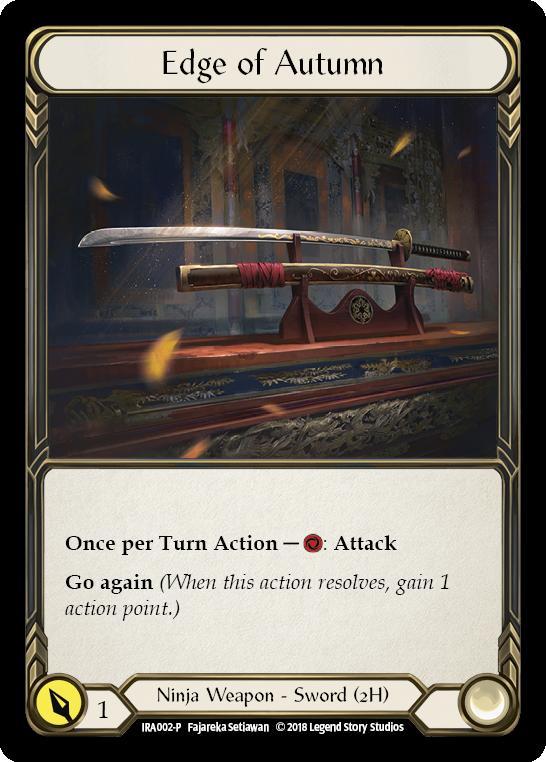
Place two weapons, or one two-handed (2H) weapon, face up next to your hero card.
Armor
Most heroes also wear armor into battle, which I think is awfully sensible. You can identify armor cards by the card type, listed at the very bottom of the card. Armor always specifies a part of the body where that piece of armor is worn: Legs, Chest, Arms, and Head. Most armor has a special ability, listed in the card description.
For example, Snapdragon Scalers are generic equipment (which means any hero can use them, which would matter to you if you were building your own deck) worn on the legs:
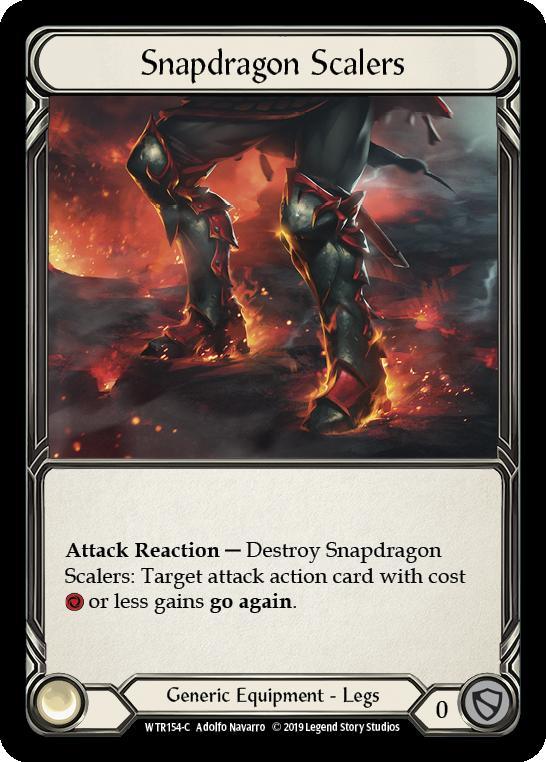
Place armor face up in your place area.
Deck, graveyard, banished zones
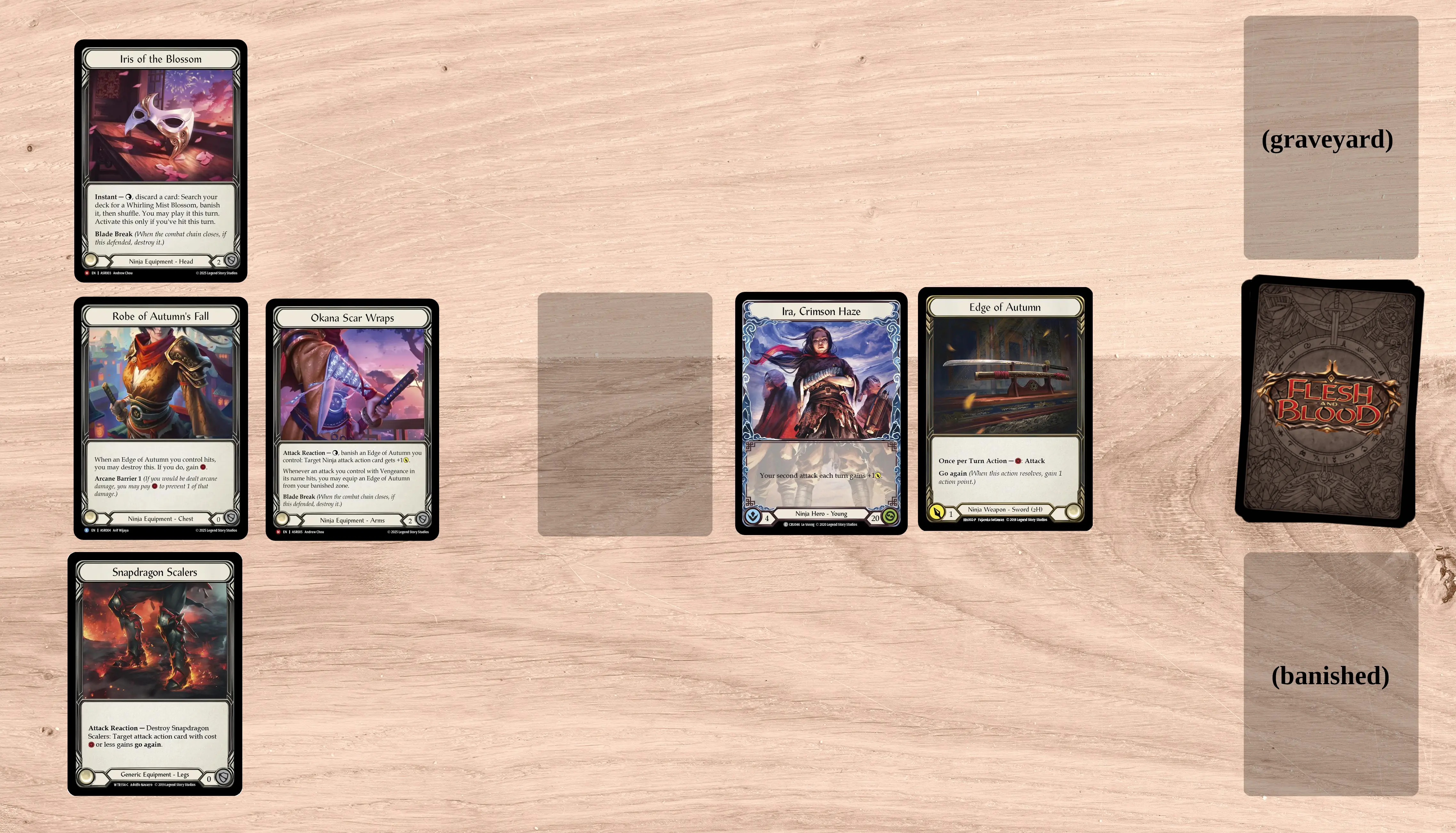
Shuffle your deck and place it face down in your Arena. By convention, the area above your deck is the graveyard (where discarded cards go), and the area below your deck is the banished zone (where cards go when they're banished.)
After setup, your Arena looks similar to this:
Play the game
The standard, always-on, base mechanic of Flesh and Blood is that on your turn, you generate resource points by placing any number of cards from your hand to the bottom of your deck. Then you use those resource points to play exactly one attack card against your opponent.
When it's not your turn, you are attacked by your opponent. You can either sacrifice whatever cards you have left in your hand to block those attacks, or you can choose to take damage from your life point total.
Those are the game rules, so all you need to know now is how to read a card.
Resource points
The top of a card is all about resources. In the top left corner, depicted as red dots, is the number of resource points you earn for pitching the card. In the top right corner is the resource cost to play the card as an attack. For example, Snatch is worth 1 resource point, and costs 0 resources to play.
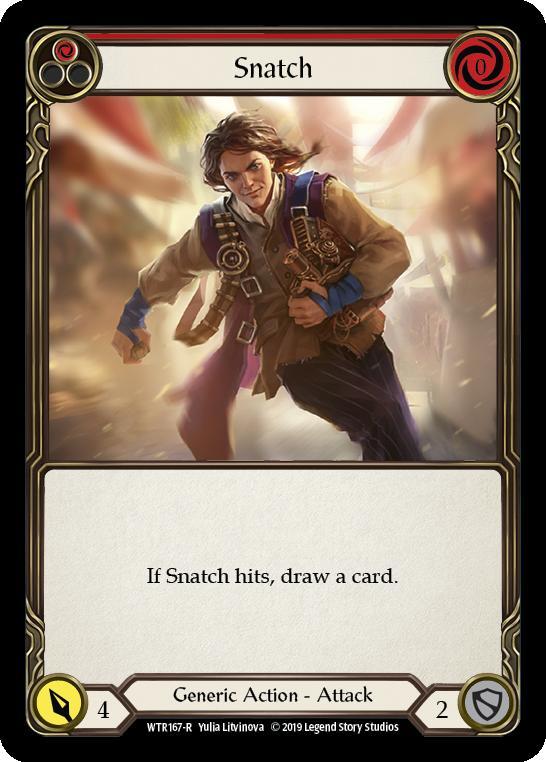
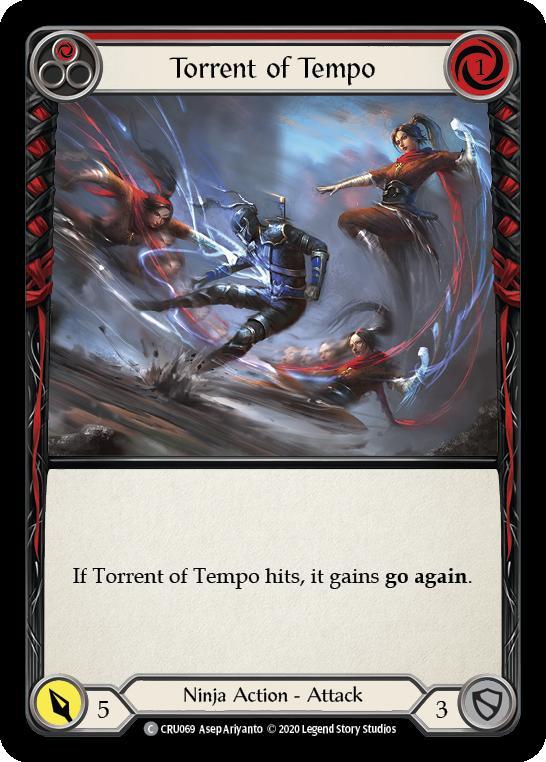
Not a bad card! It literally costs nothing to play it as an attack. On the other hand, if you want to send it to the bottom of your deck ("pitch") then you get 1 resource point in exchange for not using it right now, and then you'd have 1 resource point to spend on a more powerful card. For example, Torrent of Tempo costs 1 resource point (the number in the top right) to play:
Attack and defence
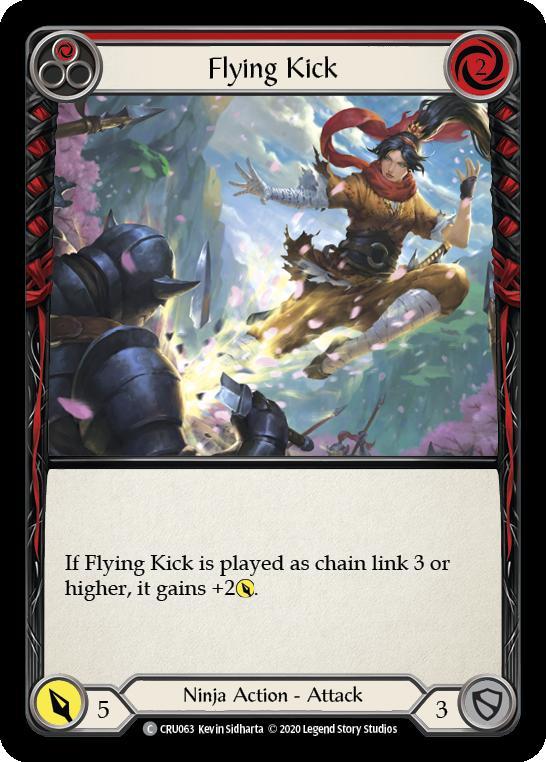
A card's attack value is displayed in the bottom left corner, and its defence value is in the bottom right. For example, Flying Kick is 5 attack and 3 defence.
Pretty much every card in Flesh and Blood can be used to generate resource points, to attack, or to defend. It's up to you how to use it.
- Attack: Were you to attack with Snatch, then you attack for 4 damage, which your opponent may block partially or completely. Then your turn is over, and Snatch is discarded to your graveyard.
- Defend: Were you to defend with Snatch, you negate 2 incoming damage. You can defend with more than one card, so for very powerful attacks you could block with Snatch and some other card to negate even more damage. After you've used a card to defend, you discard it to your graveyard.
- Pitch: Were you pitch Snatch, you gain 1 resource point, which you can spend on another card in your hand that costs resource points to play. When you pitch a card, you move it to the bottom of your deck.
Card effects
Few cards only provide attack and defence and resource points. Most have card effects, which is displayed in the card description. For example, Snatch says:
If Snatch hits, draw a card.
Should you attack with Snatch (it costs 0 resource points to play, so why not!), and your opponent takes damage from it (even just 1 point), then you get to draw a card.
Torrent of Tempo also has a card effect:
If Torrent of Tempo hits, it gains go again.
The go again effect is one of the most common and most important effects in Flesh and Blood, and it means exactly what it says. The default rule of Flesh and Blood is that you do one action, but when the go again effect happens, you go again. Playing cards that grant you go again is the key to getting multiple attacks in one turn.
End of turn
At the end of your turn, you can place one card in a zone called the "arsenal," which is a way to stash a card for later. A card in the arsenal can't be pitched, but you can pick it up to play as an attack later.
Then you draw back up to your hand limit.
After the first round (and ONLY the first round), both players draw back up to their hand limits.
Play this game
Believe it or not, that's all you need to understand to start playing Flesh and Blood. It's a trading card game, so of course there are special card effects and special power combos, and cool class features that I haven't even hinted at here. You can get lost in the nuances of this game, if you want to, and build amazing decks with internal logic structures that defy rebuttal. There's no shortage of strategic potential in Flesh and Blood.
What's really cool about it is that there's also no mana screw, because there's no mana. Every card in your deck is worth resource points, so even if the trade-off is taking damage to keep cards in your hand, you never have to spend your turn with nothing to do. This is huge, and I wish I could go back in time and play Flesh and Blood with every person I've ever tried introducing to Magic The Gathering only to watch them haplessly spend half the game without enough mana to play. Flesh and Blood solves that problem.
Every game of Flesh and Blood I've played (and I played at least twice a month for the past two years, and it's looking like it'll be the same this year) has been neck-and-neck in the end. Every battle is exciting, and down to strategies and risks decided upon by the player, not by the luck of the draw. I think Flesh and Blood is the game design that got the trading card game right, at last. It's got the lore, it's got the art, and it's got the game play that trading card games used to have. Play this game if you love trading card games.
All images in this post copyright Legend Story Studios.