I applied for a community grant from an organisation called Creative Communities to run a free miniature painting workshop. As the name of the organisation suggests, it's a grant specifically to foster creativity in your community, and luckily the committee agreed with me that the admittedly niche hobby of painting 28mm miniature sculptures and crafting terrain for games was a very creative process. After I submitted my application, and spoke to the committee in person during their funding round, I quickly found myself fully funded. I talked to the local library about running the workshop in a spare room there, and the librarian happily agreed. Last week, I ran the workshop, and it went better than I could have hoped, and I even though I was the designated instructor I learned a lot from the participants as well as from the experience. This my event report about the planning and execution of a miniature painting workshop.
Little wars
When I pitched the workshop, I leaned heavily on HG Wells' Little Wars, a classic book about the process of wargaming. If you've not read it, then you should, whether you're a roleplayer or a wargamer. It's a fascinating look at the early days of our hobby, which is why I felt it lent credence to "selling" a workshop about painting tiny toy soldiers. I was surprised to find that many of the committee members were already familiar with the concept, either from wargames or from model trains, so I had to do less convincing than I'd anticipated.
However, this also ended up leading to one of the mistakes I made while planning the workshop. I'll explain in more detail later in this event report, but a 3-hour workshop is not enough time to introduce people to building models, painting models, building terrain, and playing even a simple miniature wargame. Deep down, I knew better than to try to cram all of that into one session, but I couldn't bring myself to focus on just one aspect of the hobby. If I ever run a similar workshop again, I'm absolutely going to focus on one thing. You can build and kitbash, or you can paint, or you can play. You cannot do all 3 in a single workshop.
As an instructor, sometimes the little war is within your own head. Focus on doing one thing. If you want to do 2 things, run a second workshop some other day.
Planning is everything
As a game master, I do have proficiency in planning. I knew exactly what I needed to bring to the workshop, and I knew how to optimise the money I'd been granted. I created a budget well in advance and priced out the components I would need. I created a lesson plan, created a handout that participants could take home with them so they wouldn't forget what they'd learned and where they could buy more supplies, and handouts for game rules.
My strategy:
- Spend money on high-quality miniatures that are fun to paint
- Save money on paints by hunting for bargains and by favouring Vallejo and Army Painter
- Buy paint brushes from the $2 store, and suggest sources of higher-quality brushes
- Spend no money on terrain by building terrain from the recycling bin
This method was the correct choice.
Quality miniatures
Only one participant knew anything about Warhammer, but everyone in the room instantly fell in love with the miniatures they were given. A few participants had used Wizkid miniatures before in a dnd game after school (run by a player in my game group, not coincidentally) but everyone marveled at the detail of the Citadel miniatures I handed out. Sure, they'd seen miniatures before, but they hadn't seen a Citadel sculpt before. The money invested in those was well worth it, and each participant fell in love with at least one of their miniatures from the moment they took it out of the box.
Variety of paint options
I wanted to send everyone home with paint so they could keep hobbying well after the workshop. I'd budgeted for 8 participants, so that's a lot of paint. I already have a list of essential paints, and it's pretty minimal, but across 8 participants that's still a lot of paint. Instead, I decided that everyone would get a black, a metallic, and a highlight colour or two.
Choosing mostly Vallejo and Army Painter acrylics helped offset the price of the Citadel miniatures. Having a wide variety of paint choices ended up being really nice, too. I had a few duplicates, but mostly I bought paints primarily based on cost. I didn't go looking for specific colours, and instead ensured that I had ranges of colours, and bought whatever was on sale even when in wasn't an exact match for what I needed. When buying black, I only bought 2 solid blacks, and settled for greys and greasy brown-blacks. When buying yellow, I settled for a few Nuclear Yellow by Vallejo plus a few Bag of Bones (like Skeleton Horde, but by Vallejo Xpress Color). Nothing was precisely the shade of the primary colour slot I assigned them to, but it was close by on the spectrum.
In practise, this turned out to be a real luxury for the workshop participants. As it turns out, everyone has unique tastes, so there was never an argument over the same shade of any colour. On the contrary, the variety of brands and shades made it easy for participants to find something they liked for their miniature.
Cheap paint brushes
I bought paint brushes that were even cheaper than Army Painter brushes, but I did test the brushes before buying a lot of them. I wanted cheap brushes, but I didn't want brushes that didn't function. After I'd established that the Reno Art brushes I bought were practical, I bought enough brush packs to ensure there would be at least one brush for each participant. Because they were packaged in groups of 3, I only had 3 of each size, but the miniatures were all variable in size as well, and different participants favoured different size brushes, so it worked out for the best, just like having an assortment of paints did.
Specifically, I bought Reno Art brushes, but only because I couldn't find where to buy Das Roman. I eventually did find Das Roman brushes, and it still bugs me that I didn't find them until a day before the workshop.
I also bought a big pack of painfully cheap brushes for priming and painting terrain. They worked well for that.
Miniature kits
I bought two starter sets from Games Workshop. One was an Warhammer: Age of Sigmar set and the other was Warhammer 40,000. Given that New Zealand is kind of famous for fantasy, I considered going all in on Age of Sigmar, but I kept imagining kids coming to the workshop exclusively because they'd been playing Space Marine 2 and I didn't want to disappoint. In reality, nearly everyone favoured the fantasy models, and the lad who ended up loving the 40k models only got those models because the fantasy kits had all been taken.
It's an unsolvable puzzle, because you can't predict what partipants are going to like. But choice is the enemy of complacency, so were I to run a similar workshop again I think I'd choose one theme and stick with it. Whether it's Citadel sculpts or Wargames Atlantic or something else entirely, people are going to fall in love with something out of what you give them, even if that's not the same thing that they'd buy for themselves. Most participants basically had no idea such miniatures even existed, so by giving them too many choices all I did was make it more complicated for me to buy and for them to choose.
I also bought enough miniatures for each participant to take home 5 or 6 models. I wanted them to go home and continue painting, without the hurdle of hunting down more miniatures straight away. During the workshop though, each participant knew which miniature they wanted to paint first the moment they saw it. One girl was priming a bunch of Skaven, having a lot of fun commenting on each one, but after she'd built the Grey Seer she didn't even bother building her other models because she knew she'd found the miniature she had to paint as soon as possible. Every participant had that moment, and it was never what I could have guessed. The boy with the 40k models loved the Tyranids (to be fair, they are surprisingly charming), and one girl immediately chose her Stormcast Eternal.
It was a highlight of the event that I hadn't expected, seeing the participants discover good sculpts. I sometimes feel sheepish for defaulting to Citadel models. It almost seems too obvious to say that Citadel models are the best, but simultaneously it can cause doubt. Are Citadel models really the best or are they just the most famous? Well, in a lot of ways they really are, actually, the best. That's not to take anything away from Wargames Atlantic or Victrix or any number of independent sculptors, but when it comes to reliably imaginative sculpts full of character and detail, Citadel is very much the obvious (if not best) choice. Even if the person you're introducing to the hobby is destined to collect Romans or Napoleonics, it's nevertheless a good starting point to get some experience in with a Citadel model from a weird fantasy or sci-fi setting. They're just good for universal appreciation.
Presentation of materials
To the credit of my participants' bravery and imagination, I ended up doing a lot less lecturing than I'd anticipated. Everyone caught on really quickly.
I showed them how to build, and they were off and building. All the models were push-fit, so no glue was required expect in some exceptional cases where we just couldn't get a peg to fit in a hole.
I demonstrated how to prime, and they primed their models.
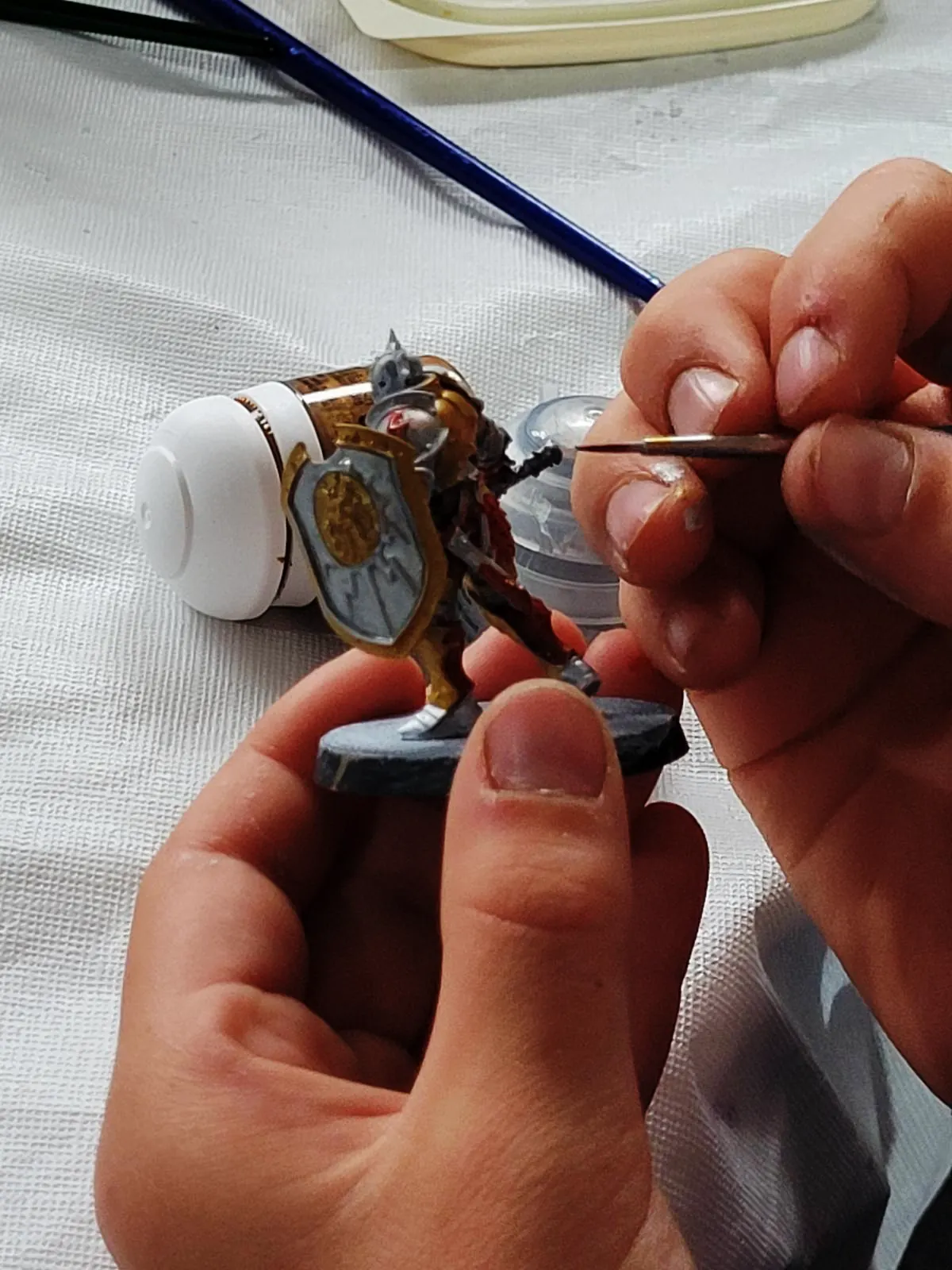
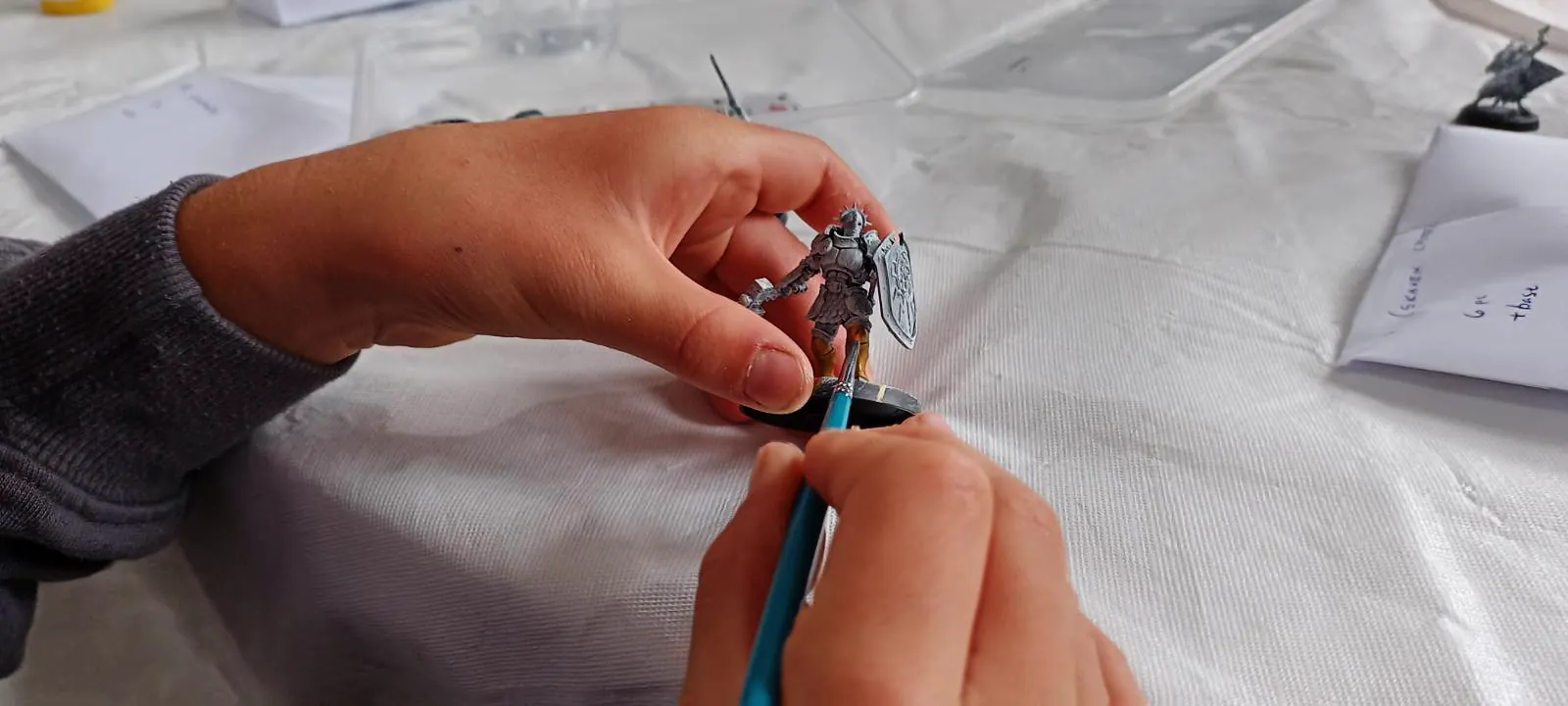
I demonstrated how to paint, talked to them about how paint tells the story of the miniature. I explained how to trick the eye with a few little paint tricks (I used impressionists as an example, and because we were in a library I was able to find a book on the subject). I also talked to them about brush control. I didn't even finish a whole miniature before they were ready to give it a go.
After that, the workshop basically transformed into a hobby meet. We painted and chatted, speculating about what kind of monsters and heroes we were creating, commenting on everyday life and the holidays just gone, and whatever else came to mind. I helped them choose colours based on the scheme they'd come up with, and they sometimes asked questions about specific techniques. Everyone was utterly engrossed, despite the workshop consisting of a wide age range from under 11 to over 21.
Gaming and painting
My one misstep was my idea that I needed to top the workshop off with gaming. To my mind, the only reason anyone would want to paint a miniature was to play a game at the end, which is odd because at the start of the workshop I very clearly told my students that the hobby consisted of building and painting and gaming but that some people just enjoy one or two of those. In the final 30 minutes, I forced everyone to stop painting and to gather round a game board, and I showed them how to play Space Marine Operations from White Dwarf 515.
Unfortunately, I presented the game as a game instead of as a story. I knew I was doing it, but I couldn't, in that moment anyway, stop myself. I'd gotten it into my head that I had to teach the game, so I ran through the rules quickly, I let them roll dice, I didn't have enough miniatures on the board for it to make sense, and I didn't present it as a creative roleplaying exercise. At the end of the demonstration, one girl just said, "Can we go back to painting now?" My thoughts exactly!
I've already mentioned the lesson I've learnt from this. Focus on one thing. Even when you try to focus on one task, there are dependencies that lead up to that task. To paint a model, you have to prime it. To prime it, you have to build it. We're back up to 3 tasks for a 3-hour workshop, despite having focused on one thing.
To play a game, there's a different set of dependencies. If you want to play the game, you have to understand character stats. To understand character stats, you must understand dice notation. To make the game more than just an exercise in rolling dice, you need a collaborative story. That's a whole 3-hour workshop.
I tried to cram 6 hours of workshop into a 3-hour slot. It didn't work, but it provided me with a valuable lesson.
New hobbyists
The important thing is that everyone had fun being creative and discovering a new possible hobby. Two of the participants had played a lot of D&D, one had played some wargames, and two were completely new to the concept of miniatures and tabletop gaming. I had fun demonstrating the mechanics of painting, but I had even more fun watching newcomers fall in love with a newly discovered hobby.
My motivation for running the workshop was to share a fun activity with others, so obviously I expected it to be fun and fulfilling. What I hadn't expected was how satisfying it would be for me to witness other people discovering (or re-discover, in one case) the joy of the hobby. It's an impossible combination of recognition and total mystery. Painting is fun and familiar, toys are fun and familiar, but I don't think most people understand that painting toys in the context of roleplaying and wargaming is a modern expression of the ancient art of storytelling. It's like cave paintings and totems and stories around the campfire. You uncover the story of the toy soldier as you paint, and you develop that story with every new detail. Getting to see people have that experience for the first time was very satisfying, and it was great to see so many unique approaches to colour schemes was actually enlightening.
Technically speaking, I'm not particularly invested in whether any of the participants continue in the hobby. It's enough for me that they were able to explore ways to express themselves. If painting toy soldiers is a fun afternoon and no more, then at least it was a fun afternoon of creativity and inspiration. If painting toy soldiers becomes a lifelong hobby, then I hope that's a creative outlet among many.