It's become a tradition of mine to fly up to Wellington for the annual KapCon RPG convention, and I did that again this year. This is my review of the event and the games I ran and played.
Convention culture
One of the best things about the conference is the people who attend. They make gaming with total strangers all day, for 2 whole days, nowhere near as terrifying as it might sound. The culture of KapCon is one that focuses largely on the stated goal of the weekend (to play lots of tabletop roleplaying games), but it does so in away that's empowering and reassuring. Everyone treats the con with exactly the importance that a weekend of playing games demands: None. People are the priority, so you're free to prioritise your own needs.
You can show up and play in every game every round,or you can visit the solo RPG library and play by yourself, or not play at all and just hang out with friends, or whatever you want. I've never been afraid of conventions because I was raised attending Star Trek and sci fi conventions,but I imagine that KapCon would be a particularly gentle introduction.
Here are the games I played over the course of 2 days. I skip some rounds because I did skip out on the conference for round or 2 so that me and my niece (who lives in Wellington and attended the con as well) could go to the Warhammer store and a comic book store to stock up on trades.
Round 1: GURPS super heroes
During the first round, I played in a super heroes game that turned out to be GURPS. I'd not played GURPS before but had meant to try it, so I was excited to finally see the system in action. There was some initial confusion about character sheets due to the way the stats had been printed (there were no page breaks between characters, so you had to sometimes ask another player for some of your stats) but it turned into a puzzle and we players managed to cope with it, if not solve it.
Once the game got started, the system was generally easy to understand. The amazing thing was that it actually felt like we had super powers in the game. There was never any dissonance between the premise of the game and what it delivered. It's painful, sometimes, in D&D when the player handbook has told players they're powerful fantasy heroes and then one of them gets killed at level 1 by a cellar rat. This game, whether by GM skill or by design, made it feel like there were real threats out on the street but that our characters had powers to overcome them.
In our party, we had off-branded versions of Superman, Flash, Static, Cyclone, and Cyborg, and each one were basically undefeatable. We quickly learnt, however, that the rest of the world was vulnerable to both common and fantastic threats, from street thugs to angry kaiju, and it was our job to serve and protect.
GURPS seemed pretty manageable to me, and I think I see its appeal. I meant to ask the GM about DR (damage reduction) and some other minor subsystems I couldn't quite reverse engineer as we played, but I forgot to, and it didn't really matter. I did see the GM do a lot of calculations behind the screen during combat, so I got the impression that there was some complexity being graciously hidden from us players. I have enough gaming systems in my life already, so I'm not going to invest in GURPS as a GM, but I'd definitely play it again.
The lesson I took away from this game was a secret trick for running high-level campaigns, in D&D or any system. If the player characters are indestructible, then stop trying to destroy them. Destroy the things they love, instead.
Round 2: Tales of the Valiant
I ran the Lost Book of Mektar, which I'd signed myself up to run before I'd actually tried it on my own gaming group. As a GM, I like to run any given adventure multiple times with lots of different groups so I get familiar with it, remember it better for longer, and also optimise the time that the adventure's fresh in my mind.
This time, unfortunately, that backfired. After running the game for my home group, I discovered that Lost Book of Mektar is not a well-written adventure. My intent was to improve the story for KapCon, and I did, but I don't think there's enough to work with in the premise itself, and I think that trying to use the adventure as a foundation for a new story only ended up holding me back. I'd have been better off setting my own story (which I do like, and will not spoil here) in a dungeon,where I'm most comfortable. It's just another nail in the coffin of the extremely disappointing Labyrinth Adventures, and I'm feeling my time with that book draw uncomfortably to a close.
The game itself went well enough, I guess. I think it definitely qualifies only as mediocre D&D is better than no D&D, both for me as a GM and for my players. To be fair, this is one of the advantages of a convention. You get to experience both the good and the bad with a wide variety of players and game masters. You can learn a lot about your own interests, strengths, and weaknesses.
The lesson I learned: Don't try to fix a poorly written adventure just because you spent money on the book. Take the loss and move on.
Round 4: Emergency dungeon crawl
I skipped round 3 due to a scheduling mix-up, but I returned for the "after hours" Round 4 (from 21:00 to 23:00.) This round is meant for the people who just refuse to go home at a reasonable hour. After all, by the start of Round 4, you've already played for 12 hours straight. This year, so many people stayed to play more that there weren't enough games to go around. I volunteered to run a dungeon crawl to ensure everyone had something to play.
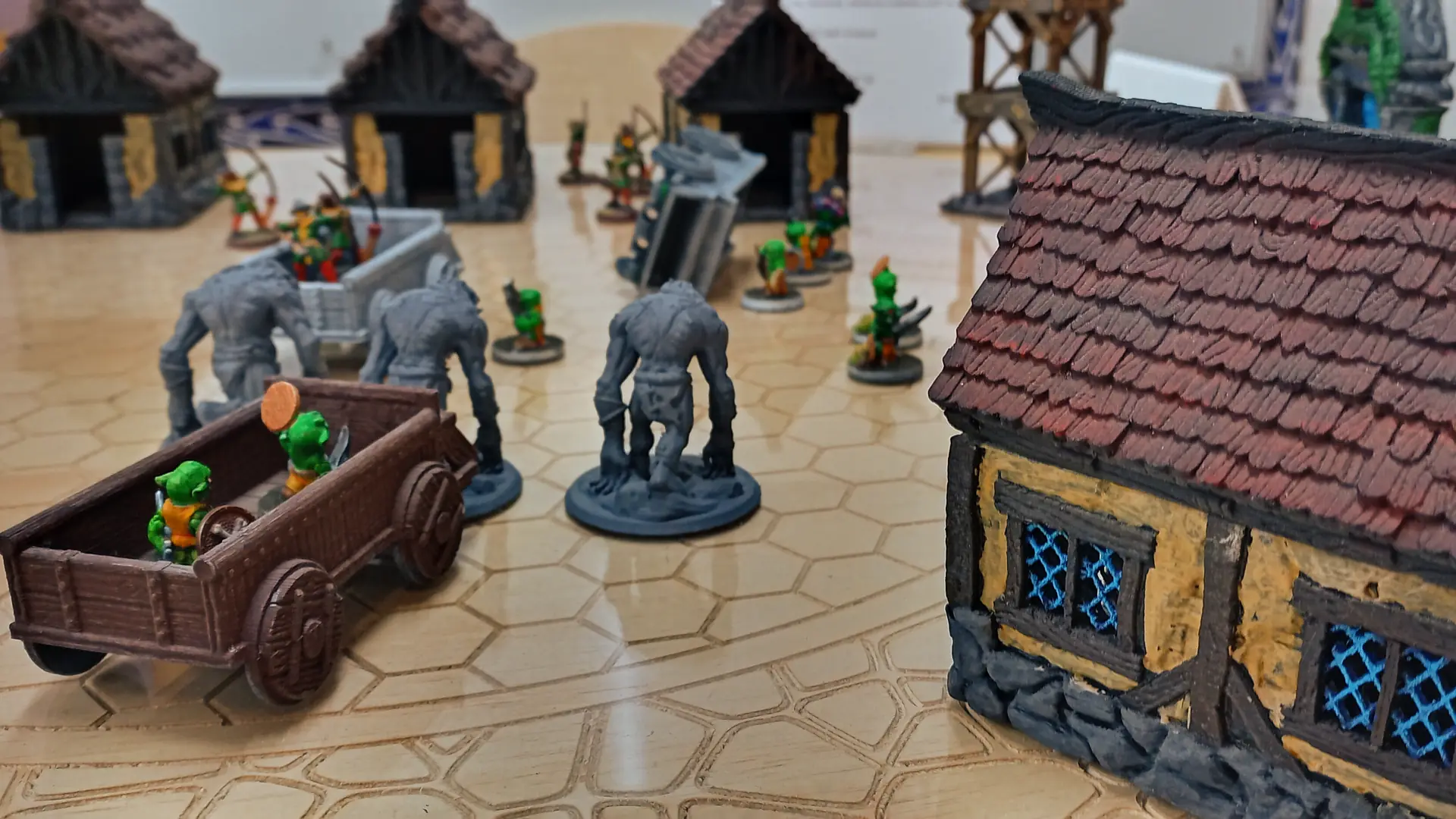
I didn't have anything prepared, so I just grabbed some Loke battle maps, the Tales of the Valiant player guide andMonster Vault, and started playing. I ran the whole game in initiative order. We treated each square on the map as 10 feet instead of 5, and the players poked and prodded their way through the map, opening doors and fighting skeletons and oozes and eventually a mimic. It was basically HeroQuest but with 5e rules.
The party took a short rest at [what I thought was] the mid-way point (forgetting that round 4 of the con only lasted 3 hours and not 4 like the others), at which point I introduced a subplot about some relics that were said to be deep within the dungeon they'd just started exploring. One local faction wants the relics to stay in the dungeon, another wants to bring them to a church because they believe the dungeon is cursed. The player characters intervene, fight one of the factions, and the game ended after a nice big skirmish.
I love this kind of dnd, the kind that walks the line between board game and RPG. I like the methodical, steady pace, and the indifference to story. I love the liberating feeling of sitting down at a table and comfortably saying "I don't have an adventure to run, I just have this map and some miniatures" and everyone being happy to join in. It's not the only way to run dnd, and it's not even the only way I want to run dnd, but it is one very enjoyable option of many very good options.
A story, as it often does, emerged based on clues I was inventing (intentionally or mistakenly) along the way, but no story would have also been acceptable. I love a long campaign with lots of intricate plans and goals, but sometimes it's just really fun to sit down, put down a grid, and run a HeroQuest-like skirmish wargame.
Round 5: Ragadorn Ale-house Brawl
The next morning, I ran Ragadorn Ale-house Brawl with 8 players. For an obscure game included, probably as an after-thought, in a compendium for a niche solo RPG, getting 8 actual individual humans for a game was entirely unexpected to me.
After everyone at the table had picked a character, I played the Landlord as the GM, and was left to run with the Adventuress as the 9th player. For the first 20 minutes, I introduced the game and the world of Magnamund, provided an overview of the rules, and distributed tokens and the custom cards I use as character sheets and rule reminders. When designing my cards, I accidentally gave the wrong card backing to the Helghast card (I designated it as a common item card), but functionally I think this happy accident works as well or maybe better than the method of designating a Helghast in the game rules. If you hand out special items that boost stats to everybody, and then one player awkwardly goes the entire game without using any noticeable bonus, then other players could start to guess who got the Helghast card. But if the Helghast is included with a round of mundane items (such as a chair or a bottle or a bucket), then it's hard to tell whether a player character hasn't thrown a chair because there's been no reason to throw a chair, or because you've found the Helghast. In a way, that could be an unfair detriment to the Lone Wolf player, but then again it also puts the Lone Wolf player on equal footing as everyone else, because every other goal is pretty well concealed. I guess you learn everyone's goals after you've played enough games, but investigation is a good challenge and nobody ever accused this game of being balanced.
Game play proceeded better than I could have hoped, with players making secret deals with one another, only to betray one another later. There were several times when the entire table erupted in surprise or mock outrage about the mayhem, and even the landlord started making attacks after she decided that people standing on the gaming table was interfering with her gambling business (the Magician had killed the Croupier by that time!)
That's another lesson I learned: The game master must declare that the Croupier does not carry the winnings of gold crowns on his person, unless you want the Croupier to become the most valuable target in the game. I actually didn't mind, so I'm not sure how I'll handle it the next time I play.
I'd forgotten that I hadn't told anyone that the Helghast existed, so I had to have one of my serving girls chase down the relevant character so I had an excuse to take the player out into the hall and explain why he had a Helghast card in his hand. It was tricky, but possibly a method I'd repeat for a future game. Keeping players in the dark on their first play-through was a net positive for everyone. In fact, the highlight of the game for me was when the Helghast finally did appear on the board. When the Druid finally died and I swapped out the miniature for a Helghast miniature, everybody at the table lost their minds. None of them saw it coming, because I hadn't even hinted that such a threat or mechanic existed. It was one of those pure roleplay moments where the divide between player and player character becomes non-existent. It was one of the all-time most satisfying gaming moments of my life, made all the better because it hadn't occurred to me to expect it.
I overheard players in the hallway later talking about the game, and I left the convention with the feeling that everyone had enjoyed the experience as much as I had. I think it was particularly special because there's every reason to believe that we're in a special minority of gamers, and even a minority of Lone Wolf fans, who have actually played the game, much less with basically a full table.
Round 6: 13th Age
This game was run by one of the players in my dungeon crawl in round 4, and although I've read the rulebook many times, I hadn't yet played. The 13th Age is one of those alternate timeline D&D implementations, having branched off from the brand during one of the many times D&D decided to abandon its fan base in the interest of filthy lucre.
The most intriguing thing about 13th Age, for me, is its effort to make combat go fast. The escalation mechanic is the most obvious way it does this. For each round of combat, all attacks get a bonus equal to the round of combat. So, during the first initiative round, your attacks get +1. During initiative round 2, you get +2, and so on.
Call it an increase in adrenaline,or a weakening of defences, or mounting resolve, but the longer combat lasts the more dangerous it becomes. This is definitely a mechanic I'm stealing for my games (probably in the form of a magic item so that the players see it as a benefit and not as yet-another-rule-to-follow.
It so happens that a magic user in the party also had an at-will ability to drain the last 10 hit points from an enemy that was at 10 HP or less. That's another ability I'll be stealing in the form of a magic item. It's an elegant way to shave off 10 HP from the ever-growing pool of HP high-level monsters acquire, and who knows maybe I'll make it a percentage instead!
And finally, I think there were also penalties for creatures at half HP ("staggered"), which is a third mechanic I'm stealing and really should have been using all along anyway.
An interesting game technique was a montage mechanic the GM used to get us through the second act of the adventure as our time to play started to draw to a close. He had each player describe a problem our party encountered as we traveled through the evil castle in search of the Big Bad, and then another player had to describe what we did to resolve that problem. It felt strange at first, and I guess I'll never know whether he only implemented the trick because he hadn't paced the adventure correctly,or whether he just decided that the middle part was boring, but it worked surprisingly well. I'm not sure yet whether it's a trick I'll ever use, or how it'll go if I do try it,but I do consider it a new tool in my GM toolbox.
Conventions and non-stop gaming
KapCon 2026 was fun, as usual. I'm not good at socialising, but I often find that when I attend a con year after year, a familiarity, if not friendship, develops in spite of everything. It's often easy to make friendly associations with people who also love gaming and game worlds, and I always find it refreshing to be around a crowd that has become, over the years, comfortable.
If you've never attended a game convention, I do generally recommend them (although obviously every convention is unique.) A con is a great way to try out a bunch of new game systems, to experience new styles of play, to try out new classes or character types you don't usually play, and maybe to find a few real-life kindred spirits.